Wednesday, July 20, 1994

Army Reserves - 2 Week Annual Training

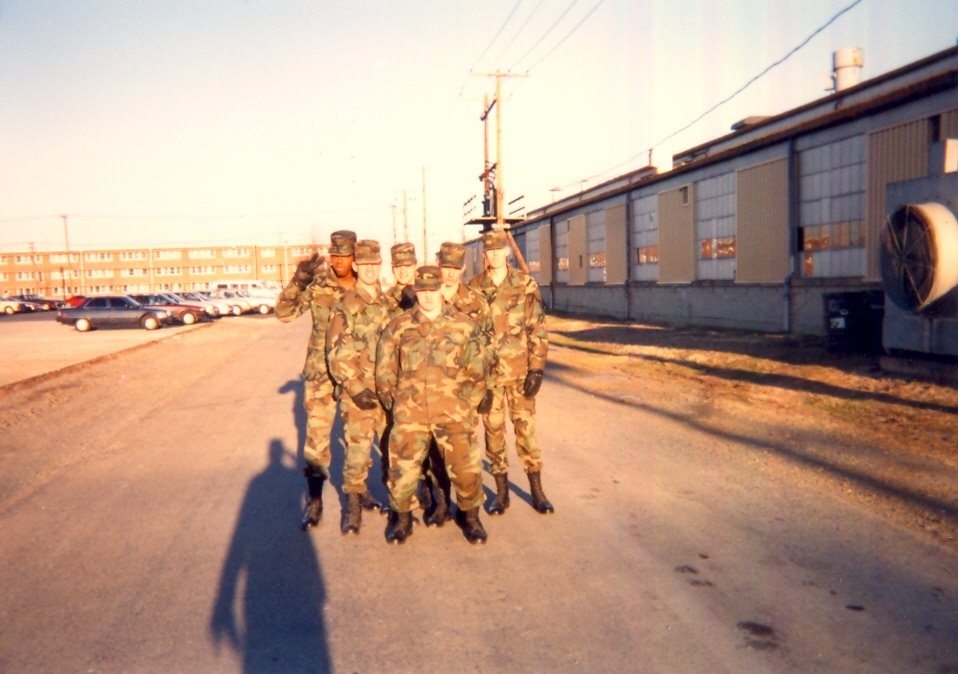
Well, we are back at Fort Eustis in Newport News, Virginia this year to practice what we learned here in school last year. I started out as a "44 Bravo" in the Army which is a Welder. When my Army Reserve Company switched from the 728th Amphibious Vehicle Unit into the 478th Transportation Company we all had to learn new a MOS (Military Occupational Specialty). For the majority of us in our new company, that was "88 Hotel", a Cargo Specialist.

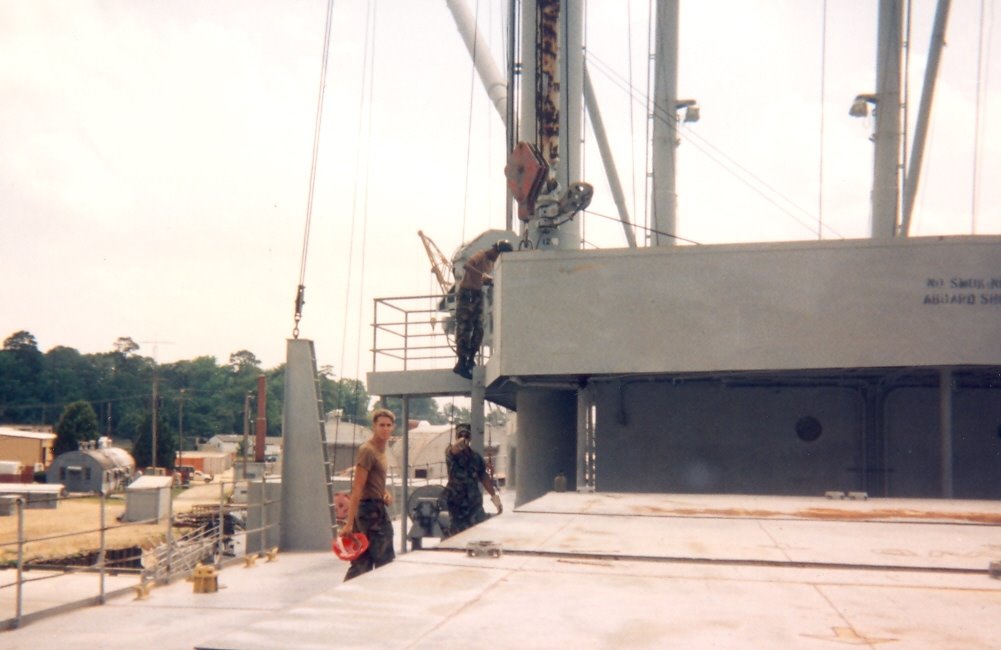
Noah Unsworth on the deck of an Army training ship
As Cargo Specialists, we had to learn how to operate cranes and forklifts to load and unload cargo and vehicles onto ships and trains. It was pretty interesting, especially when we got to operate one of those 10-story tall cranes to practice removing the huge hatch covers from the hold of a merchant marine ship. Now that we are back in Fort Eustis, we are doing a training exercise to show off our new abilities.

Noah Unsworth driving a forklift at Ft. Eustis
This year's training didn't start out great because I had received a bad sunburn at the beach a day before we before we flew out here. I was amazed to find out that that could technically get me an "Article 15" for damaging military property. That meant that even though it was torture to stand out in the blazing sun, I had to make sure the sunburn didn't effect my work. I think that it is even hotter here in Virginia than it was last year, and the humidity is off the charts. This is bug heaven as well and they all love to bite. I don't know what is worse, the mosquitoes, ticks, clouds of gnats or the microscopic chiggers that leave a red rash.

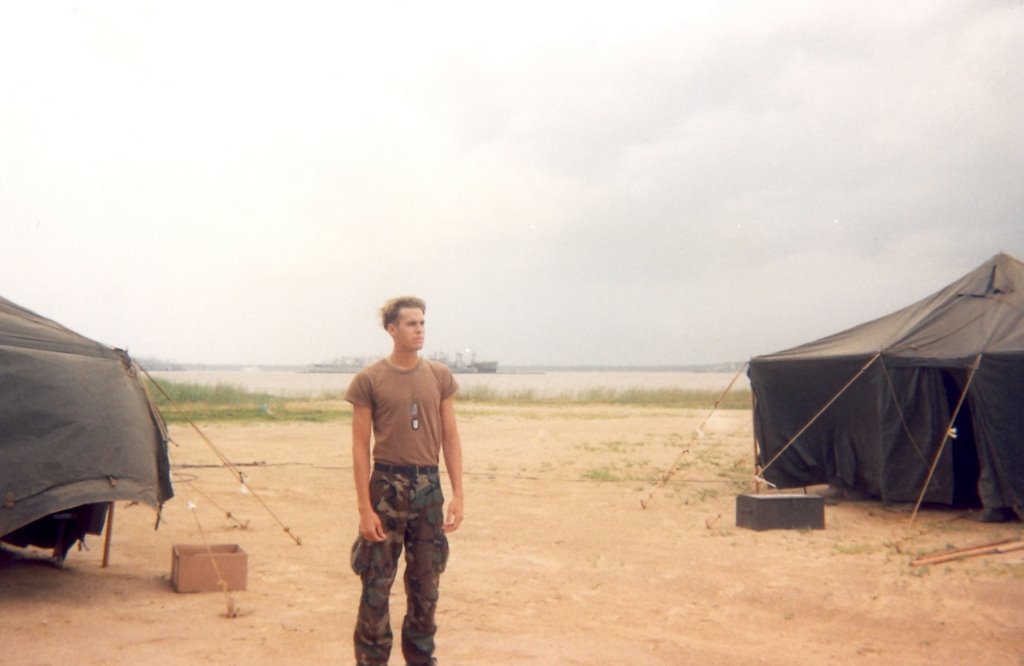
Noah Unsworth standing outside during a hurricane warning
We worked pretty hard this year with no time off at the end of the day or on the weekends. The weather started to get a little rough near the end of the exercise and we received a hurricane warning while we were out in the field. It was actually a relief because the strong winds help cut down on the heat and insects and allowed us to head back to the barracks a little earlier and relax.

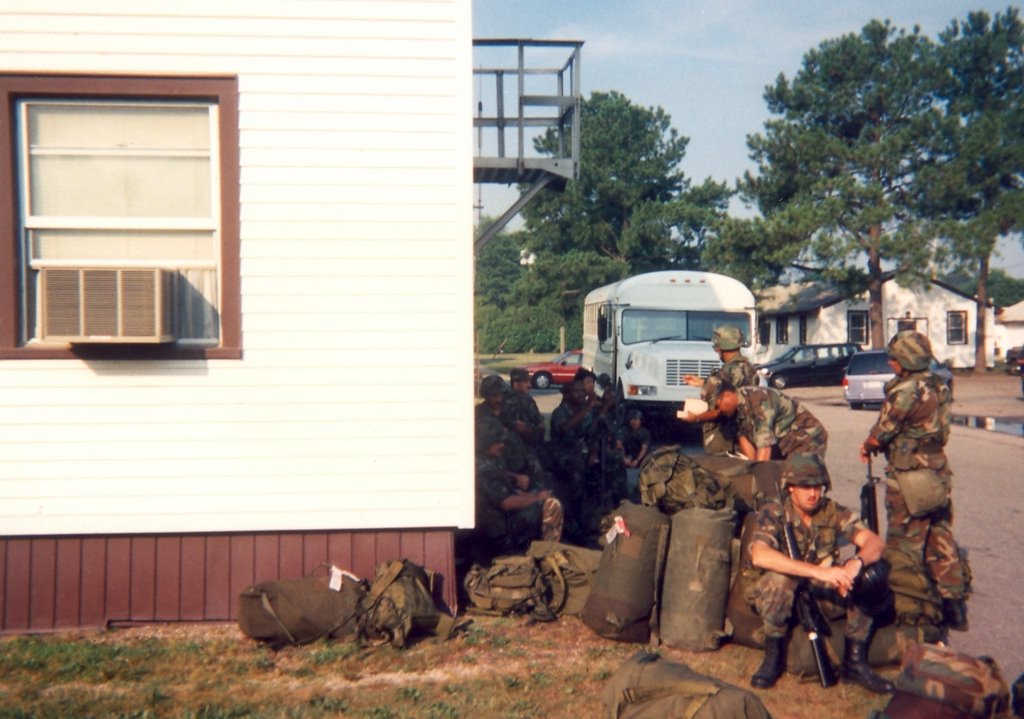
Our Army barracks at Fort Eustis

Saturday, January 22, 1994

Seattle Cabin (Ski Trip to Stevens Pass & Whistler)

This year instead of our usual cabin trip to Big Bear Lake in the San Bernardino Mountains, northeast of LA, we decided to go somewhere different. We got a nice cabin in the little town of Skykomish, directly east of Seattle. I flew up with Jeremy, Shauna, Greg, Pete, Scott & Savannah to Seattle where we got a rental van and drove out to our new place. The cabin was right on the South Fork of Skykomish River which rushed right through the backyard. It was a beautiful spot but it was raining with no snow on the ground anywhere.

A few of Jeremy's cousins lived nearby and went with us to Stevens Pass Ski Resort to go skiing. Stevens Pass was in the Cascade Range, 78 miles east of Seattle on Highway 2. We had been told that there was snow a little higher up at the resort, but we were pretty worried by the fact that it was raining for most of the drive to the ski area, but just like magic the rain turned into snow right at the last turn before pulling into the parking lot. The good news was that it was snow. The bad news was that it was very wet snow.

Stevens Pass Trail Map
Stevens Pass is pretty big compared to Big Bear and it also had several runs going down the backside of the mountain into Mill Valley. We all decided to try snowboarding for the first time. It took me and the rest of the guys about two runs down the beginner slopes before we felt comfortable to take a lift to the top of the mountain. Snowboarding is great in that it really feels like surfing or skateboarding. It felt really nice to not have to worry about my knees but I soon found out about the perils of catching an edge and smacking my head against the ground. Having to sit down in the wet snow all the time with the snowboard, we were soon soaked to the skin. Jeremy, Pete and I stayed for the night skiing after everyone else went home to the cabin when the sun went down.

The next day we made a trip into Seattle to give our muscles a rest from all the snowboarding. We were all groaning from how stiff we all felt. In Seattle, we first checked out the Pike Place Market, the highlight was watching the fish mongers fling the large fish back and forth to each other at high speeds and visiting a small S&M shop. Afterwards, we went to the Aquarium, rode the little Monorail over to the Space Needle and visited some coffee houses for which the city is famous.

Portrait of Noah drawn at base of Space Needle
Jeremy's cousin, John, had told us that he had found some mushrooms growing in front of the town hall which he claimed were magic mushrooms. So one night in the cabin we made some mushroom soup, really bad tasting mushroom soup. I could barely choke it down. Most of us felt nothing but a bad taste in our mouths, but I think it had a placebo effect on a couple who swore they could feel something. I can't believe we ended up doing that, the mushrooms could have been poisonous or something.

After a few days in the wet snow of Stevens Pass, we decided to make a day trip up to the Whistler Ski Resort in Canada. We had to get up really early and leave around 4am so we could get to the mountain with a decent amount of time to ski. It was a long drive, but very scenic along the Sea to Ski Highway outside of Vancouver. Jeremy, Pete and I were the only ones who bought lift passes and we explored both the Whistler and Blackcomb mountains while the rest decided to stay at the base and explore Whistler Village.

Whistler Blackcomb Trail Map
Jeremy, Pete and I were amazed by the size of the place and the length of the runs. The best part was skiing on the glacier atop Blackcomb, but we were disappointed that the mountain closed so early at 3pm before we had a chance to fully explore it and swore we would be back. When we got picked up by the rest of the gang afterwards, we found out that they had had a horrible day. The van had been towed to an impound lot for parking in a illegal spot and they had spent the rest of the time trying to get it back before coming to get us. That sucked.

On January 17th, a large earthquake struck Los Angeles, but we missed it because we were still up in Washington. It was our last day of the trip, but it was on the news everywhere at the airport. The epicenter of the quake was in Northridge where Greg's father lives, we were happy to hear he was unhurt.

Tuesday, July 13, 1993

Scott's Bachelor Trip to Laughlin, Nevada

Scott got married on Sunday, but last weekend was the more important experience, the bachelor party. We decided to go all out and make it a four day bachelor trip to Laughlin as well. The festivities started off in the early afternoon at the house of Jeremy's friend, Benji, for a party that all our friends could attend who wouldn't be able to make the trip. I won't go into the details of the party's activities, but I saw some amazing stuff. Afterwards, we headed out to Laughlin. Scott drove with his best man, Chad, who had flown in from Mississippi and I drove with Jeremy and the two Gregs in the mini-van we had rented.

Hanging out on Lake Mohave in speedboat
It was very hot in Laughlin when we arrived late Friday evening. To help our wallets, we had planned to camp instead of getting rooms at a hotel. We set up our tents at the Lake Mohave campgrounds and tried to get to sleep. I think I was the only one who was able to fall asleep in the heat and everyone was tired and grumpy in the morning. We tried moving our campsite out onto a sand dune on the lake after picking up our reserved speedboat, but it was pretty miserable because a strong wind kept blowing sand all over our stuff. Chad decided that he couldn't take another night in a tent so we all drove into Laughlin hoping to find a room on a busy July 4th weekend. We lucked out at the Flamingo Hilton where they were able to give us their last available room. We didn't tell them that there would be six of us in the small room.

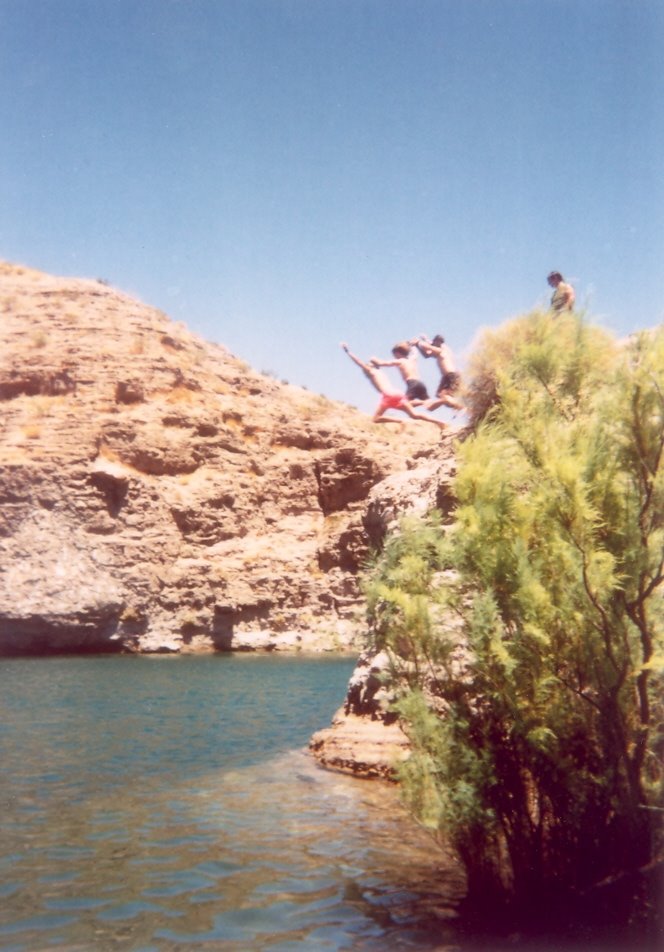
Jumping off a rock in Lake Mohave
Now that we were all in a good mood again, we went back to Lake Mohave. Cruising a long way up the lake we found a nice inlet with calmer waters where we could practice our kneeboarding. After everyone had enough tries, we anchored the boat further back in the cove where we did some swimming, snorkeling and found a fun rock to jump off of into the water. After a couple of leaps into the water, Jeremy realized that he had left the keys to the van in his pocket and now they were at the bottom of the lake. We spent a few minutes trying to find them before deciding to head back to find a locksmith, but the boat wouldn't start no matter what we tried. After waiting more than a hour for help, we ended up getting the boat to start. We sped back to the marina and were able to get to the locksmiths fifteen minutes before it closed up for the weekend. That was close.

Getting ready to cruise the boardwalk in Laughlin
The great thing we found out about Laughlin is it's dual nature. You get the outdoor fun of Lake Mohave combined with a mini-Las Vegas. Laughlin's hotel casinos are located right alongside the Colorado River, just south of the Davis Dam which holds Lake Mohave. One of the fun things to do is walk along the river boardwalk that links all the hotels from the Flamingo Hilton to the Golden Nugget. Much nicer than walking the Las Vegas Strip. We all had a good laugh when Jeremy walked into a wall right as he was giving a smart aleck remark to some kid.

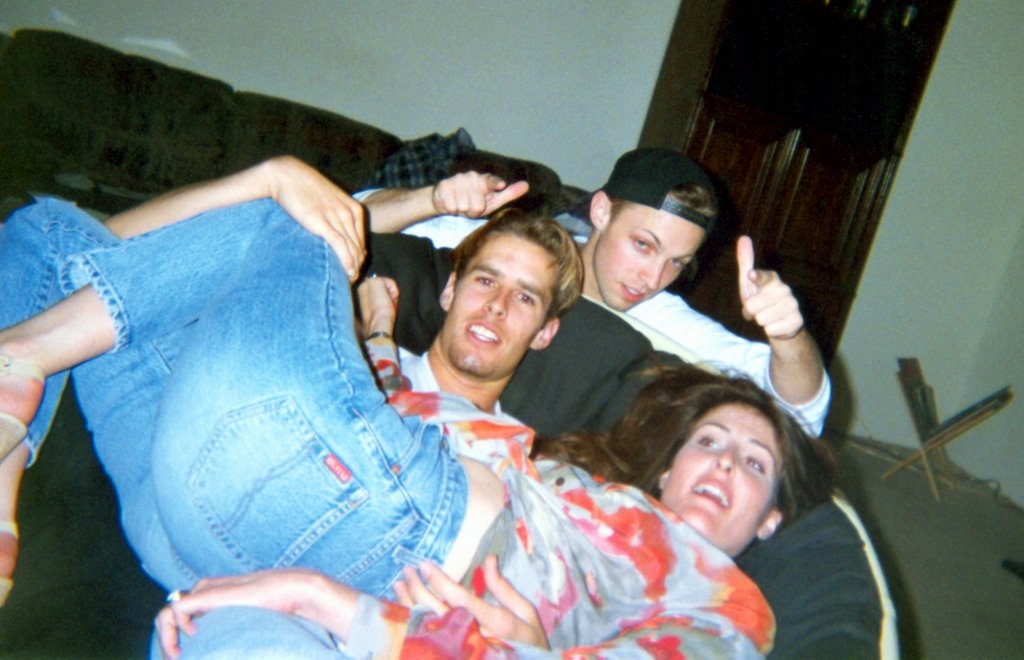
Jeremy with a few girls we met on the Boardwalk
Sunday, July 4th started out auspiciously when we got up later than we wanted and headed out to the lake. We had the music blasting and Greg had just lit up a joint in the back seat of the van when we were pulled over for speeding. We were franticly rolling down the windows and sliding open the side door of the van as the cop walked up to us. It was pretty pathetic attempt to clear the air and the cop probably smelled it anyway. After each of us had given a nervous sounding "No?" to his direct question about whether we had been smoking, he gave us a stern lecture and let us off with a warning. No speeding ticket either. Turns out he was leaving the next day for a vacation to Hawaii and didn't feel like doing the paperwork if he took us in to the station. Whew!

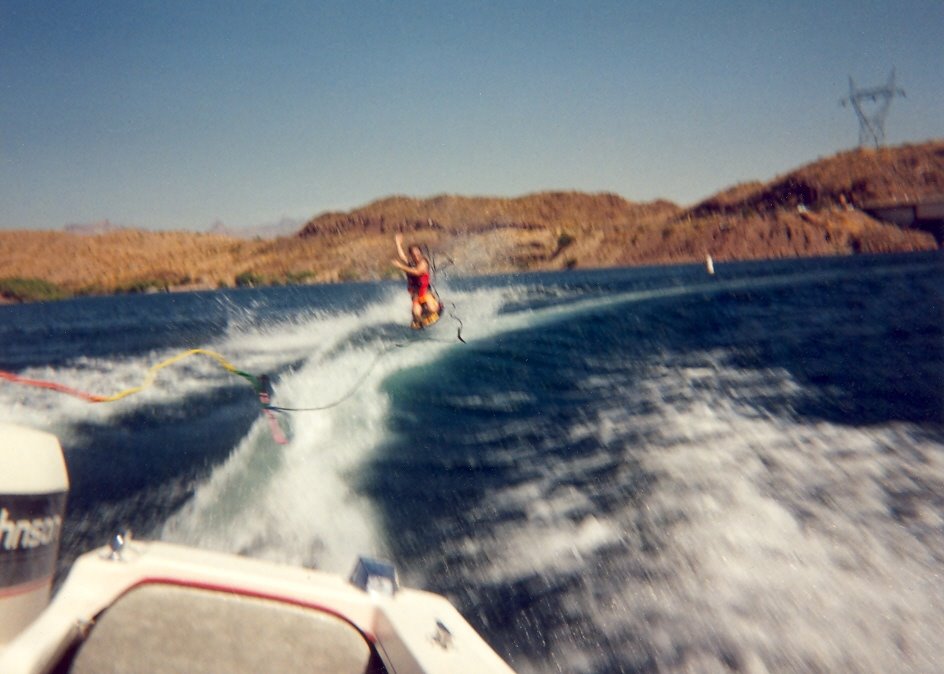
Jeremy kneeboarding on Lake Mohave
Glad to be on the lake and not in jail, we kept the boat near the top of Davis Dam and had fun mooning a few of the passing cars. The water was much colder there, creating a sharp contrast with the scorching heat. Our beers quickly got warm which was bad but the Zimas ended up tasting better warm. We drank a lot on this trip (never leaving our hotel room without a beer in each hand), but strangely we never got drunk. Maybe it was the heat. In the water, I was getting pretty good on the kneeboard, but when I tried to copy Jeremy's 360 spin I ended up wiping out pretty spectacularly. It would have been funny, but I pulled a muscle in my back and the pain still hasn't gone away. It was getting pretty dark when we were heading back to the marina. We got stopped by the rangers, but they let us off with just a warning for being out too late on the lake.

We had so many things start to go wrong on this trip but miraculously turn out okay that we started to count them. The seventh and last one was pretty cool. On our last day we were pretty low on cash. We had enough money to either pay for the gasoline to fill up the speedboat so we could return it or fill up our cars for the long drive back home but not both. As we were debating what we should do in the lobby of the Hilton, Greg played the last three quarters in his pocket into a slot machine. He won one quarter. Dropping in the last quarter, he hit triple sevens and won $175 dollars. Now flush with cash, we were able to fill the boat and our cars to make it home. Since we were starving, we were able to have a nice meal as well.

Monday, August 31, 1992

Parachute Jump from 3,000 Feet

I jumped out of an airplane yesterday at 3,000 feet. It was a static-line jump where you jump out of the plane by yourself and a cord that is attached to the plane pulls the chute open as you fall away. Kinda like the parachute jumpers you see in World War II movies.

Noah jumping out of airplane at 3,000 feet
I went down to the San Diego Air Sports Center in Otay Mesa with Jeremy, Scott and Greg. It was Scott's Birthday, so Jeremy and I decided to go jump with him.

It was a long, stressful, but exciting day. We got there early and had to sit in a class that lasted till around 2pm as we learned all the ways to fix a problem if the main chute has a problem opening or how to release it and pull the reserve if all else fails. We also learned how to correctly jump out the door of a mock-up plane and they taught us how to steer the parachute and come in for a safe landing.

The worst part of the day was the long wait at the picnic tables after the class listening for the loudspeaker to call our names to suit up and board the plane. It felt like we were waiting for our turn before the firing squad. My stomach was doing flips. We tried to stay calm by watching the small planes taking off on the dirt airstrip, trying to spot early jumpers as their chutes opened high above us.

When they finally called our names we went over to the equipment shed to get our jumpsuits, helmets, altimeter, 2-way radio & most importantly, our parachute. Mine was #11. We tried to steel our nerves as the small Cessna landed and our jumpmaster rushed us out to load us onto the small plane. Since I was the lightest, I would be jumping last and I was squeezed into the small place on the floor where the co-pilots seat should have been. My view for the rest of the flight was the steering wheel in my face unless I looked back out the open door.

Beside the jumpmaster and the pilot, there were four of us jumpers crammed into the rickety little plane with lots of duct tape holding things together in the interior. I started to get a little airsick as the plane gained altitude, but it might have been just fear. The first jumper had done this before and was pretty calm but it was still shocking one moment seeing someone sitting in the doorway behind me and the next he is gone with a bang as the metal clip on the end of his cord hit the bottom of the plane.

Scott was next and I can still vividly see the look on his face as he yelled, "Oh Shiiiit" as he dropped out of view below the door. The plane would circle around between each drop to get back into position. Jeremy was next and then he too was gone. Then it was my turn. Strangely, all my fear left me as the jumpmaster shouted, "Next" and I maneuvered around the small plane to get closer to him. I felt like I was on automatic pilot as he hooked the static-line to my parachute and patted me on the shoulder to signify that I was ready to hang my feet out the door and prepare to jump.

I had to fight the strong wind as I held onto both sides of the door frame with my hands and hung my feet out the door. I edged out until my butt was barely on the edge of the frame and waited. The jumpmaster shouted, "Jump!" and I threw myself out into the sky. My adrenaline must have been in overdrive because my vision went black and the next thing I remember was the loud pop as my chute opened with a strong jerk.

It took a second for me to regain my senses, but then I remembered to look up and check out the condition of my parachute and reach for the two handles above my head. I lucked out, my chute had opened perfectly with no line twist or end-cell closure to fix. I was then free to enjoy the scenery and steer the parachute back and forth by pulling on the handles while frequently checking my altimeter. I tried a sharp spin by pulling on one handle until I was almost horizontal with my chute on the third rotation.

Around 1,000 feet, I started to follow the treeline alongside the airstrip and look for the man on the ground with the big arrow who would guide all of us first-timers into the landing area. He led me along the trees and then turned me around for the final approach into the field. My parachute was designed to descend around 14 miles per hour but if you pull both handles at once you can brake and slow down for a much softer landing. Another man was holding paddles at the landing spot to indicate when to brake for the landing. I looked at the wind sock and watched the guy's paddles carefully as I neared the ground. I braked hard right before the ground but was surprised at how hard I hit as I rolled onto my side to absorb the impact. I didn't feel that I was going that fast.

I gathered up my parachute and carried it across the field with a huge smile on my face to meet up with my friends and take off and turn in my gear. Scott, Jeremy and I were all on an adrenaline high for awhile afterwards reliving our experience and describing it to Greg who had watched from the ground. By the time I got home last night, I was mentally exhausted and ended up going to sleep early. I was burnt out.

Tuesday, June 30, 1992

Army Reserves Party


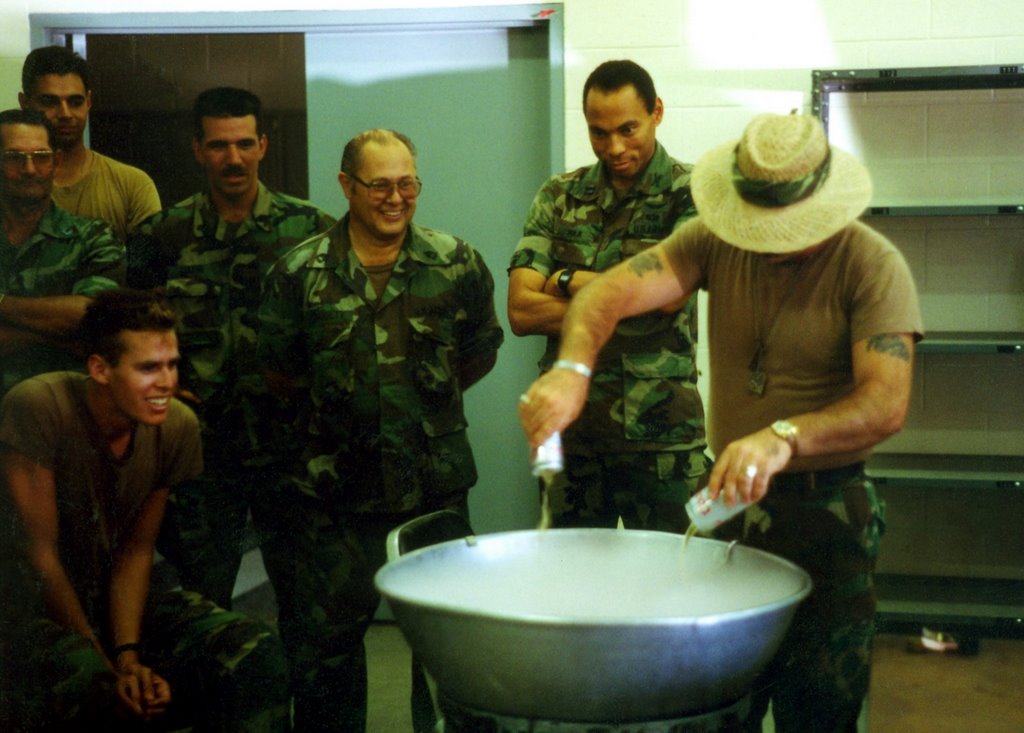
At the end of this year's two week Army Reserve drill, my unit, the 728th threw a little party with some special alcoholic punch brewed up for the occasion. A little dry ice gave it a nice effect. I couldn't keep track of all the things the sergeant poured into the metal bowl, but it tasted great.

Noah Unsworth looking on as Sergeant pours

Friday, October 25, 1991

Bungee Jump from Hot Air Balloon

I went bungee cord jumping out of a hot air balloon last weekend with Greg. The name of the company I jumped with was Bonzai Bungee and we met up with them in the early morning with a group of people in a field off of Mira Mesa Boulevard.

Bonzai Bungee had a large hot air balloon that they kept tied down by three pickup trucks. It was an interesting system. One jumper at a time would have his bungee harness attached and then climb into the basket. The balloon would rise until the three ropes were taut at 300 feet. The jumper would then climb out of the basket onto the little wooden ledge and jump after the crowd had counted down from 10.

It was fun to watch. After the jumper would stop bouncing at the end of the bungee, the balloon would slowly float to the ground. All of us spectators would grab ahold of the thick bungee cord to keep it off the ground and untangled while the next person was hooked up. I wasn't nervous at all on the ground while waiting for my turn to jump. Even when it was my turn to get hooked up and climb into the basket I felt fine.

The fear finally found and hit me hard as I stepped out onto the little ledge and looked down at the hard dirt 300 feet below me. There was no net or air bag below to break my fall if something went wrong and my mind wanted to rebel. It actually took two countdowns before I summoned the courage to leap, but once I did the feeling of falling was amazing. As I sprung up from the bottom of the bungee's stretch, I did fun flip in the air that I had seen several other jumpers perform before me.

After my first jump, I had the opportunity to do another jump so I took it. The second jump was a little more painful because the bungee cord caught me as I flipped and gave me a nasty jerk between the legs. Ouch! Greg rode up with me in the basket both times even though he didn't jump. At the end of the day I got a nice T-Shirt and a video of my two jumps.

p.s. A reporter from Channel 7 News was also there to jump and do a story on the bungee company. He said it should be on TV sometime next week.

Tuesday, February 05, 1991

My Army AIT at Aberdeen Proving Ground, MD

I just finished my Advanced Individual Training (AIT) at Aberdeen Proving Ground in Maryland where I learned how to be a 44 Bravo, the Army MOS for a Welder. Operation Desert Storm has started with the bombing of Baghdad before I got home, but the coalition ground forces have not yet entered Iraq. (Update: I got home two weeks before the ground invasion to free Kuwait from the Iraqis.)

Random Observations & Experiences:

I learned four types of welding; Oxyacetylene Welding, Arc Welding, TIG Welding (Tungsten Inert Gas) and MIG Welding (Metal Inert Gas). TIG Welding was my favorite and Arc Welding was my least. Having a small drop of molten metal fall into my shirt and down into my pants while I was arc welding an overhead pipe was not fun.

This first thing we wanted to learn at AIT was the Weekend Pass System:

A Pass (Whole Weekend Off - Friday to Sunday Evenings)
B Pass (Off-Base Pass w/Nightly Bed Check)
C Pass (On-Base Only w/Morning & Evening Formations)
No Pass (Confined to Barracks and Mess Hall - Army Uniforms Only)

The pass system was mostly based on PT scores. I spent most of AIT with a B Pass. It took me a few weeks to get my push-up numbers high enough for it, but I was never able to get an A Pass because my 2-mile run times never got low enough. I spent one week with a crappy No Pass because of a bad cramp during a sit-ups test and that was normally my easiest event.

Noah and his classmates outside the Army Welding School Building
If I thought that the food at Basic Training was better than I expected, the Mess Hall at AIT was even better. They had really great food. A favorite item of mine was getting two eggs over easy and making myself a breakfast sandwich with bacon, cheese and toast.

Private Riggs was the only other soldier from my Basic Training Company to take the same AIT Training as me.

We had a nice Rec Room in our barracks. We had two Pool Tables and a big screen TV. After the isolation we experienced in Basic Training it was nice find out what was going on in the world. We all eagerly watched any updates on Operation Desert Shield.

We had a lot of inspections in Basic Training, but the number increased greatly in AIT. Every inch of our room, locker and uniforms had to be perfect order according to our soldier's manual. After a few inspections, I got the hang of it and they got easier as I kept about 25% of my things unused and ready to go in display condition. We also had to keep our camouflaged BDUs (Battle Dress Uniform) that we wore from getting too wrinkled. We had to frequently dry-clean them and they were starched so heavily that they could practically stand on their own.

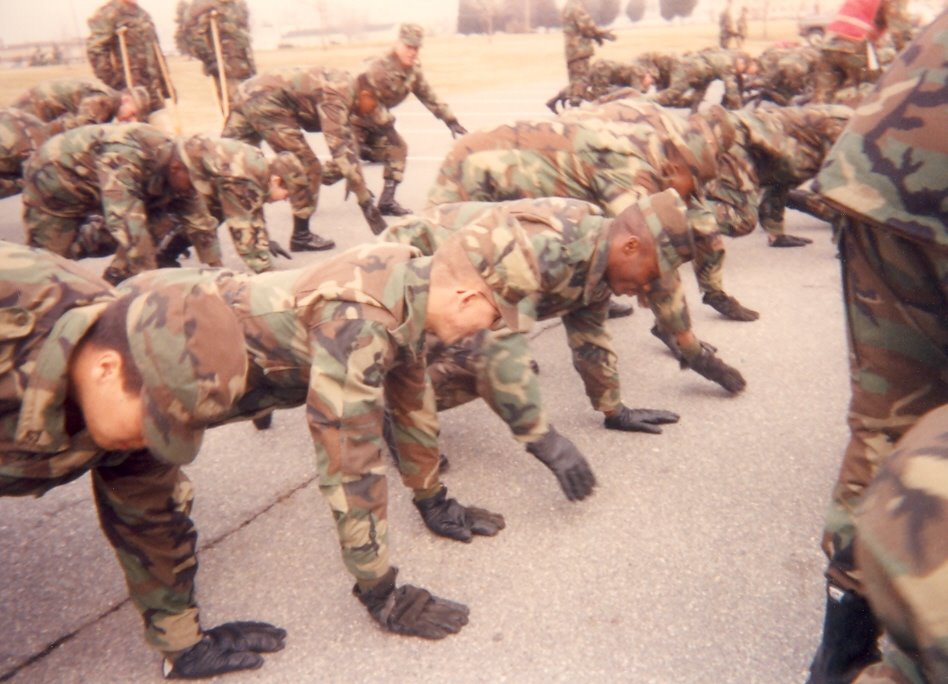
Platoon in Front Leaning Rest Position
One of the worst things about AIT was Physical Training (PT) at 5am every morning before school. Since it was the winter, it was freezing outside. At least we got knit caps and gloves to protect us a little bit from the wind cutting through our thin sweats. We would alternate between Strength and Agility days.

Besides the regular Fire Guard duty we had take turns doing one night of guard duty for a gate out in the field. The weather was so freezing the night my squad had the guard duty that we had to limit the shifts to only 15 minute at a time. Every minute seemed like a lifetime as we counted every second before we could go back into the tent with the heater.

Another of the duties we had to perform at AIT was Flag Duty. It was a week-long task for five people that was rotated through the company. We would raise the flag at the Battalion Headquarters for 6:30am Reveille and lower the flag at sunset. Three of us would handle the flag while the other two would stop traffic in the nearby street.

We had to take a lot of Drug Tests in AIT. It seemed like every other week we were woken early to line up in the hallway and wait for our turn to piss in a cup. Sometimes the wait was unbearable if you were at the back of the line. Lots of guys hopping from one foot to the other.

Noah on a broken down tank during Guard Duty
Growing up in California my experience with snow was very limited. Spending the winter in Maryland I had plenty of opportunities to shovel snow. It wouldn't be that bad if the snow didn't stick to the shovel so much. Actually, I enjoyed the snow for the occasional snowball fight and the temperature actually warmed up while it was snowing. It seemed a lot colder when we had clear skies with lots of wind and ice on the ground.

One of my pet peeves during AIT was all the smoking & tobacco chewing. Smoking was banned in Basic Training, and I think all the nicotine addicts are trying to make up for lost time. Nothing is grosser than half-filled spit cups.

My other little day trip besides Washington DC, was to the city of Baltimore. We walked around the city a little bit and visited the Baltimore Aquarium out on a pier in the Harbor. It was a pretty big building with a tropical rainforest greenhouse on the roof. I liked how the escalators crisscrossed high up over the large sting-ray and shark pool as we checked out the fish on each of the five levels. We also watched the dolphin show.

For the last month of AIT, I graduated to a two-man room. It was great after the eight-man rooms in Basic Training and the four-man rooms at the beginning of AIT.

Noah in his nice two man room at AIT
Our two-week Christmas Vacation home was cancelled because of Operation Desert Shield in Iraq. My classmates who were active duty soldiers were really upset because they would not get an extra vacation before leaving for Iraq at the end of school, but for me and other reservists it just meant finishing two weeks earlier to go home.

Normally near the end of AIT, students spend a few days out on a field exercise (FX) practicing our infantry training. Because of the situation in Iraq, we still stayed out in the field in tents, but we spent all our time cleaning out old barracks for the ITT Reservists who would be staying there before heading to Iraq.

In Basic Training, I respected but feared my Drill Sergeants and did everything in my power to stay invisible to them. In AIT, it was different. The Drill Sergeant for my platoon was a great guy, easy-going but still tough when he needed to be. Whenever he would drop us for push-ups, he would get down and do them as well to lead by example. I spent several nights hanging out with him in his office.

I received my first rank promotion at the end of AIT. I went from an E-1 Private to an E-2 Private. There is not much difference except an E-2 gets to wear the single stripe on his uniform (mosquito wings).

Link to my Basic Training post at Fort Dix, NJ

Saturday, January 05, 1991

Trip to Washington DC

I convinced some of my friends from my AIT Company to make a day-trip into Washington DC with me on the weekend. The capitol is about 60 miles south from our base at Aberdeen Proving Grounds in Maryland. Driving into the District, we went through the most run-down section of any city that I have ever seen in my life. It was a sharp contrast with the gleaming center when we arrived.

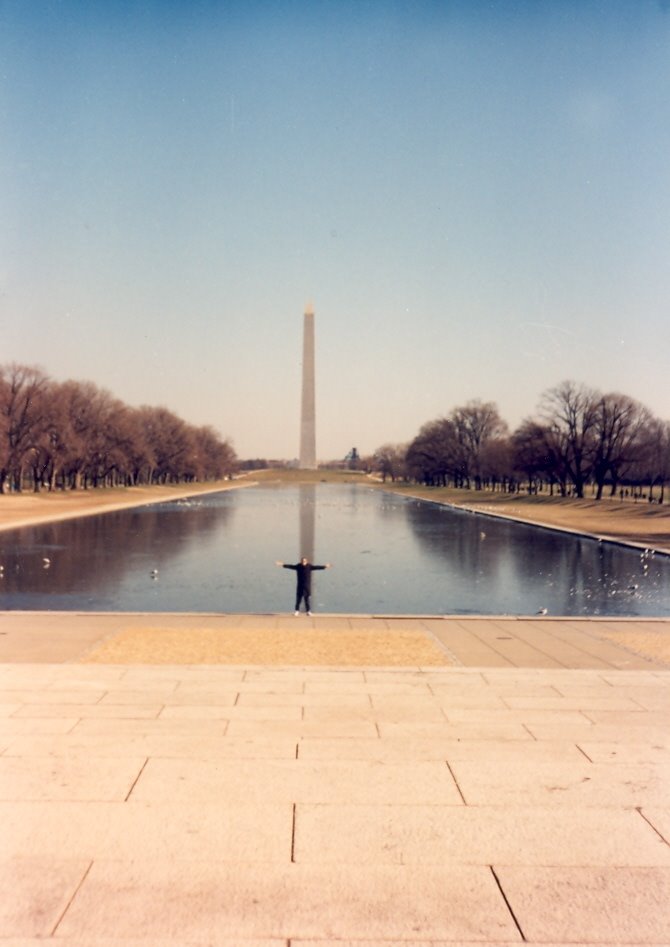
Noah in front of Reflecting Pool & Washington Monument
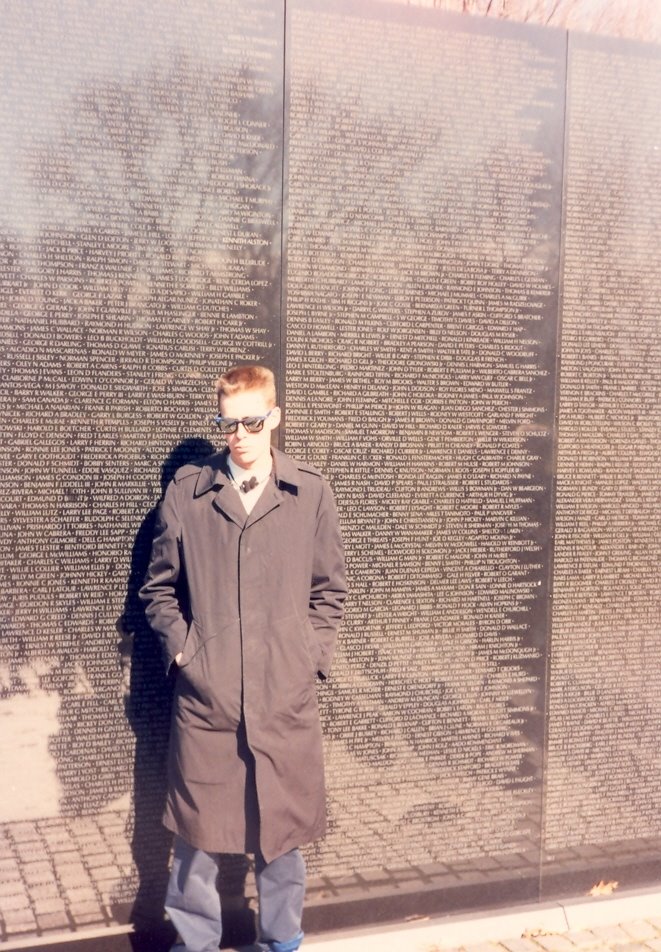
Our first stop was at the Lincoln Memorial in front of the reflecting pool at the west end of the National Mall. After visiting Lincoln sitting on his large chair we headed over to the nearby Vietnam Veterans Memorial. It is a sublime memorial in the way that the black granite wall covered with over 50,000 names blends down into the grassy landscape around it. It was a little difficult to find and we had to backtrack to find it. I really liked the statue of The Three Soldiers nearby.

Noah at the Vietnam Veterans Memorial
It was a sunny day but it was freezing. The wind cut like a knife as we walked down the Mall towards the Washington Monument. We waited in line and took the elevator to the top of the monument which is 555 feet tall. Even through the narrow rectangular windows, we had great views of the surrounding area. After descending we walked over to the White House nearby, looked though the fence and observed a few groups protesting about Operation Desert Shield.

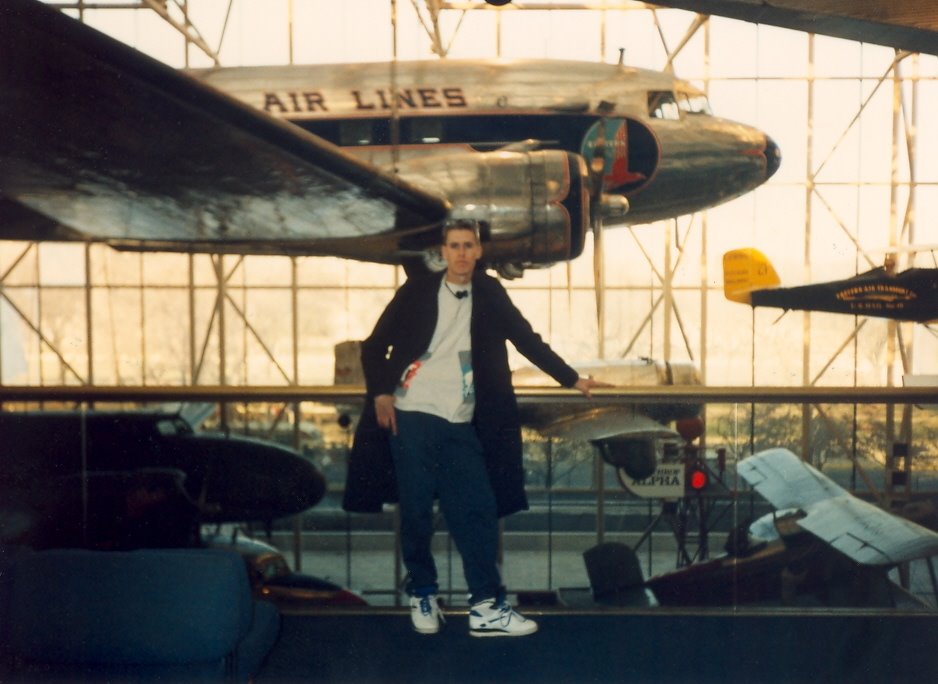
Noah in front of DC-3 at the National Air and Space Museum
We only had time to visit one of the famous Smithsonian Museums so we went to the National Air and Space Museum. It is a cool place to visit with all the historic planes and spacecraft hanging from the ceiling, including the Wright Flyer and the Spirit of St. Louis. Afterwards we walked over to the U.S. Capitol building and the nearby Supreme Court for a brief visit and checked out a Washington Metro station. The last place we visited was the National Archives where we got to view the Declaration of Independence, the Constitution and the Bill of Rights under heavy plates of bulletproof glass.

Tuesday, January 01, 1991

Letter from Army AIT - 1/1/91

Hello Dad,

Here is some more traveler checks. Could you put them with the rest? Thanks!

I found out I won't be graduating until January 29th, a week later than before. I go to FTX next week. It's going to be cold. It snowed here last Friday. I like it better with the snow. It was warmer out than when we just had ice.

I finished I Annex which is Auto Body. I start E Annex tomorrow.

Oh well, I gotta go now.

Love, Noah

-----------

PVT. UNSWORTH, NOAH
Co. B 601st ORD BN
APG, MD 21005-5245

Wednesday, December 05, 1990

Letter from Army AIT - 12/5/90

Hey Dad,

How are you? I am doing fine. I passed my PT Test. I did 48 push-ups, 66 sit-ups and 14:27 on the 2 mile run.

There was a little bit of snow today. You could see it in the air, but it never got to the ground.

I have some bad news. I won't be coming home for Christmas. The Army has cancelled all Leave and Christmas Exoduses because of Iraq. I'll be stuck here for Christmas and I'll be getting my ticket refunded.

I will be graduating a little earlier, January 24th. I finished the Arc Welding C Annex yesterday. Today I started D Annex which is MIG and TIG welding. I have done it before so I hope I am okay at it.

I just got paid so I am sending you 600 dollars in this envelope. Will you put it with the other Traveler's Checks I sent home? Thanks.

Well, I hope you get this letter. I miss you.

PVT. UNSWORTH, NOAH
Co. B 601st ORD BN
APG, MD 21005-5245

Tuesday, October 16, 1990

My Army Basic Training in Fort Dix, NJ

I have graduated from my Basic Training at Fort Dix, New Jersey.

Random Observations and Experiences:

I was pretty nervous about going to Basic Training, especially since I watched "Full Metal Jacket" a couple weeks before leaving. Strangely, my biggest fear after watching the movie was thinking that I would have to deal with the same open bay toilets. Scary! I was very relieved to find out that was not the case when I arrived. But, I was just as eager to leave for Basic Training because it was going to be my first time flying on an airplane.

Saddam Hussein invaded Kuwait 11 days before I left for Basic Training. We spent most of our time at Fort Dix in the dark about the military buildup of Operation Desert Shield in Saudi Arabia except for the basic details provided to us by our Drill Sergeants. It wasn't until after Basic Training when I was at AIT that I was able to catch up on the news.
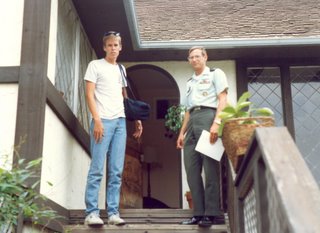
Noah Unsworth leaving for Basic Training
I thought Basic Training would start as soon as I arrived at Fort Dix but I spent a week in a Reception Battalion. It is the orientation time where we waited to be assigned a Basic Training company and received all our new uniforms and equipment. We would spend all day in long lines going from station to station getting yelled at by Drill Sergeants. We got our heads shaved, and went through medical check-ups and received multiple immunization shots in each shoulder. The shots were very painful because they used a needle-less gas-pressurized injection gun like they used on Arnold Schwarzenegger in the movie, "Total Recall". The painful welts from the shots would last for days. It was fun getting all the cool Army gear (except for the Army "Birth Control" glasses), but by the end of the week I couldn't wait for Basic Training to start.

If Orientation week was a shock to the system, then starting Basic Training was a lightening bolt out of the blue. I will never forget the first hour after being turned over to our new Drill Sergeants as they started yelling at us at the top of their lungs. They made us dump all our gear on the pavement and would yell out an item for us to quickly find and hold up before placing it in our large canvas bag. If any of us were too slow or held up the wrong item, they would make the entire platoon stuff all our gear back into our bags and carry them on our backs as we ran around the large barracks building. We ran with our heavy bags around the brick building at least 10 times (as they chased us with insults), each time making us start our inventory all over again.

Basic Training Army Portrait
The toughest part of the first week was mental. We had a million tasks we had to accomplish and hardly any free time to do them. I am pretty sure this time pressure is planned so they could punish us over and over with push-ups for everything that wasn't done in time. We spent most of our time taking classes lead by our Drill Sergeants on things like learning Army ranks, how to salute, organize our locker, and wear our uniforms correctly. The rest of the time was spent learning how to march in formation and physical training.

My new home for 9 weeks of Basic Training was in the 3rd Squad of Alpha Company, 3rd Platoon. (A-3-26) There was 3 platoons in the company and we spent all of Basic Training competing with each other. Our platoon was called the Rangers and we were the best because we won most of the competitions. Our platoon would receive a streamer for each competition won and we would attach it to our platoon's flag, the guidon. By the end, our guidon was covered in streamers while the other platoons had only two or three each. I think one of the reasons was because we had a good Platoon Guide and Assistant Platoon Guide. Private Davis and Private Santamonica were picked by Head Drill Sergeant Webb at the beginning of Basic Training and they were never fired from their positions the entire time. Drill Sergeant Webb said that was a first time occurrence for him.

The first streamer we won was the weekly barracks cleanliness inspection. It was the only streamer that could be awarded and then taken away. We won it every week except one time in the middle of Basic Training when another platoon took it from us. We really got chewed out for that but we won it right back the next week and kept it for the remainder of time. We really had a good cleaning system down and I learned how to use a floor buffer like a champ. The other benefit of this competition was the winning platoon got to carry the company's guidon as well.

The barracks where we lived was a three story brick building. It was spotless due to the constant cleaning but it did have problems in the bathroom. Most of the sinks and toilets in our bathroom didn't work. It was pretty amazing to see 50 guys taking turns trying to crowd around three working sinks in the morning. I would find myself have to squeeze between others just to get some water on my toothbrush while trying not to get someone else's shaving cream on it. The upside is there was less things we had to clean before the morning formation.

Our Platoon and Company Guidons with all the streamers we won.
There are three phases to Basic Training, the Red, White and Blue. You can tell which phase a platoon is in by the color of their guidon. The Red Phase is the toughest where the Drill Sergeants are actively trying to break you down and you are still trying to adjust and learn the basics of Army life. The White Phase is where the Drill Sergeants start to build you back up and you spend most of the time out on the ranges learning how to fire weapons. The Blue Phase is the last phase where you take the final tests and go camping in the field. By this time, we all felt good about ourselves and everything began to feel second nature. The Drill Sergeants started to act nicely as long as we didn't mess up and we also began to respect the job they did to train us.

Everyone was assigned a Ranger Buddy near the beginning of Basic Training. We shared a bunk and had to be responsible for each other. If one of us got busted for something, the other would be punished as well. My Ranger Buddy was Private First Class Rodgers. He had a higher rank because he had already graduated from college before enlisting in the Army.  We got along well, but I think he thought of me as more of an annoying younger brother than as a friend.


Some guys can't handle Basic Training once they get there. We only lost one from our platoon who I had hung out with during the orientation week. He had seemed okay but he got desperate to leave once Basic Training started. He ended throwing himself off his top bunk to the floor. He didn't hurt himself that badly but he got his wish and he was processed out of our platoon after a week.

Fort Dix was one of the only two bases that has Basic Training for female soldiers. The barracks for the girls going through Reception was right across from ours and on the same floor. In the little time we had before lights out, we would hang out by the windows checking out the girls and vice-versa. The girls enjoyed teasing us by flashing us every once in awhile. This lasted less than a week before some recruit in 2nd platoon flashed back something he shouldn't have and a Drill Sergeant saw it from below. Our whole company was pulled outside onto the yard and punished with exercise. After about ten minutes, our platoon and 1st platoon were allowed back inside, but 2nd platoon was stuck out there for awhile. The next day the females were moved to some other location.

One of the very first thing we were issued was the recruit's bible, the U.S. ARMY SOLDIERS MANUAL OF COMMON TASKS. We had to carry it in our pocket at all times and if we had any free time we were supposed to pull it out and work on memorizing it's contents. The manual was very thick and covered almost every conceivable topic relating to being a soldier; infantry fighting tactics, using and maintaining our weapons, first aid, guard duty, radio communications, map reading, reacting to nuclear, chemical or biological attacks, army regulations, and maintaining our uniform. We had to learn everything to pass the comprehensive Common Task Test (CTT) near the end of Basic Training.

Basic Training 3rd Platoon
Army Physical Fitness Test (APFT) - The three parts of the PT Test we had to pass by the end of Basic Training were Push-Ups, Sit-Ups and 2 Mile Run. We would start with the Push-Ups and then how many Sit-Ups that we could do in 2 minutes. We had to keep perfect form or the improperly executed repetition would not count. During the two minutes, we were allowed to rest in the official resting positions. For Push-Ups that meant raising our behinds up into the air or sagging in the middle without touching the ground and we could rest in the up position while doing Sit-Ups. If we rested on the ground, our time was immediately up. Our final test was the 2 Mile Run which was run on a 1 mile track we had to circle twice. I started out Basic Training pretty weak but I passed the Final APFT with 33 Push-Ups, 57 Sit-Ups and 14:30 on my 2 Mile Run. Push-Ups was the hardest for me and the only one where I had to practice extra in our little bit of free time. I was very happy to pass with 2 over the minimum.

Marching in Formation or "Drill and Ceremony" is one of the first things we learned in Basic Training. On the first day, the Drill Sergeant picked 4 Squad Leaders to go along with the Platoon Guide and Assistant Platoon Guide. While our two top leaders, Davis & Santamonica, were never fired, the Drill Sergeants replaced the Squad Leaders frequently, especially in the first two weeks. The main reason was mistakes made while learning how to march and Squad Leaders had the toughest job because they were at the front. One or two mistakes and they were replaced. As we got better at marching, I really began to enjoy the precision of 50 soldiers marching in-step as 1 unit. My favorite moments were when our platoon would march right through the center of other platoons that were in our path. Two platoons marching head-on into each other, 100 men threading through each others ranks and passing out the back.

Marching was also the cause of our platoon's worst punishment of Basic Training. Marching back from lunch, the Squad Leaders made an early turn onto the path outside our barracks before the Drill Sergeant's shouted command. He was livid and had us doing non-stop push-ups, jumping jacks and flutter kicks in the classroom with the doors and windows closed. That is called "getting cycled" and he didn't let up on us until the walls and floor was covered in sweat which took over a half hour.

One of the worst tasks we had to do in Basic Training was pulling Fire Guard duty about once or twice per week. The reason it was so bad was it took an hour away from what little sleep we enjoyed at night. The best time to be assigned Fire Guard duty was first or last so our sleep wouldn't be interrupted in the middle of the night. When pulling guard duty, we had to put on our complete uniform, boots included, and keep a watch out to make sure the barracks didn't burn down. The hard part was trying to stay awake while counting down the minutes for the next soldier to take over. Normally we would find and wake the next guy up with about ten minutes to go so he would have his uniform on and be ready to take over when our time expired.

In Basic Training, your bed has to be made to exact specifications every morning with hospital corners. Allot of guys would sleep on top of the covers so they wouldn't have to make them in the morning, but that was not for me. I always slept comfortably under the covers. I wasn't going to ruin my sleep to save two minutes in the morning.

Confidence Course Rope Swing
During Basic Training we had to go through the Confidence and Obstacle Courses. I found them to be one of the most enjoyable things we had to accomplish. I really liked the Confidence Climb which looks like a vertical wooden ladder that goes 30 feet up into the air. It is tough because the thick wooden bars get further apart the higher we got. To get over the top and down the other side, we needed to stand on the second highest bar to reach the top. The Weaver was the only one I failed. To complete it, we had to weave our bodies under and over the bars up one side of an inclined ladder and down the next. I slipped while under a bar near the top and fell to the ground flat on my back. I wanted to try it again but I didn't get a chance.

In Basic Training, we did a lot of NBC (Nuclear, Biological and Chemical) training. The most important item we trained on was our Gas Mask; how to clean it, how to use it and how to put it on very quickly from the carrying pouch we wore on our hip. The ultimate test of our training was the trip to the Gas Chamber for a little Gas Mask Appreciation. I was only a little nervous because it was hard to be truly frightened when I had no clue as to what CS Gas (Tear Gas) felt like. We put on our gas masks and the Drill Sergeant led us into the chamber two squads at a time. Drill Sergeant Sparks had us line up facing each other and had the other squad remove their masks first. It was shocking to see the row of guys start to freak out across from us as the Drill Sergeant went down the whole line asking each person a question before allowing them all to put their masks on. When it was my squad's turn and I pulled off my mask, I felt nothing for a few seconds and then I understood why it was called tear gas. I seemed to lose all control of the fluids in my face as my eyes began to pour tears, and my nose and mouth began to run and drool uncontrollably. The pain was intense but the embarrassment from the uncontrollable slobbering as I tried to answer Drill Sergeant Sparks' questions was the biggest thing on my mind. After we put our masks back on and were marched outside, the Drill Sergeants had us run around the field to get fresh air back into our lungs.

I really enjoyed the Bayonet Training where we learned to fight with the bayonet attached to the front of our rifle. We learned and practiced all the proper bayonet moves with our M16 rifles but the fun part was when we got to put the training to use in one-on-one combat with pugil sticks. We got all padded up and the Drill Sergeants refereed each fight, giving a point for every clean hit using a correct bayonet move. The first person to 3 points won. It was exhausting, but I won both of my matches. I found the hardest move to defend was the forward thrust. We were also taught a little bit of hand-to-hand combat, mostly concentrating on different throws.
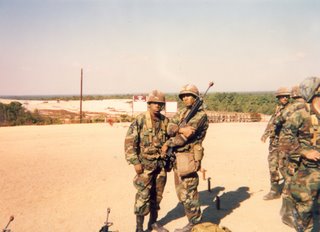
Platoon Leader and Assistant Platoon Leader for 3rd Platoon, Alpha Company (A-3-26)
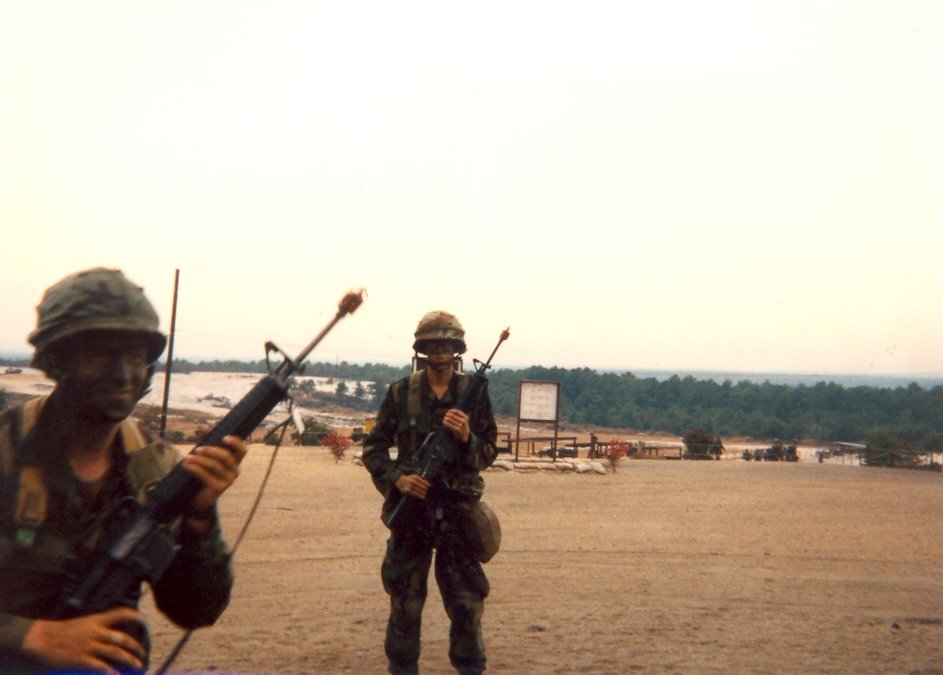
As a soldier, one of the most important things we learned was how to fire our M16 A1 rifles. In the 4th and 5th week of Basic Training we spent a lot of time out on the ranges learning Basic Rifle Marksmanship (BRM). The first thing we learned out on the rifle range, besides safety procedures, was how to zero the sights on our weapon. This meant firing three rounds into a special grid target. The object was not to hit the center of the target at first, but to get a tight shot group with all three holes close together. Based on how far our shot group was from the center of the target we would adjust our sights appropriately. We would do this three times, each time trying to get our shot group closer to the center. The trick to getting a tight shot group is proper breathing and trigger squeeze technique. Firing our rifle in the brief pause at the end of an exhale and squeezing lightly on the trigger with the meaty part near the end of the index finger.

When it came to being tested, we practiced on a Pop-up Target Range. The targets ranged between 50 and 300 yards at six different distances. (I only hit one 300 yard pop-up target in my entire time out on the range.) We were given 2 magazines with 20 rounds each. We would fire at the first 20 targets in a foxhole with a sandbag supporting the front hand and the last 20 targets in the prone position without the support of a sandbag. There were three passing levels for the Basic Rifle Marksmanship test; Marksman (23 out of 40 targets), Sharpshooter (30 out of 40), and Expert (36 out of 40). My best score was 31, but too bad it wasn't on my final qualification test. I normally scored in the high 20s and I ended up with 28 to receive a Marksman Badge.
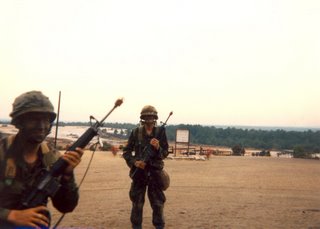
Noah Unsworth at Rifle Range
The fun part of firing our rifles was countered by the amount of time spent breaking down and cleaning our M16 A1 rifles. We would spend hours in the classroom after spending all day on the range, cleaning and lubricating every part of the rifle. The Drill Sergeants had a very through inspection at the end before we could turn them back into the weapons vault. He would run a clean white cloth through all the rifle's parts and if any black smudges turned up, we had more cleaning to do.

One of the weapons we had to learn how to use was the Hand Grenade. We practised pulling the pin and throwing dummy grenades that only had a small fuse that popped. We were tested on the Hand Grenade Course where we had to throw the grenades over and around obstacles into large circles on the ground or into buildings and vehicles. The course was pretty easy physically, but the main test was making sure we had the proper throwing and safety techniques. After we graduated the course, we got to handle and throw two live grenades. With a Drill Sergeant making sure we used the proper technique, we would pull the ring on the grenade, stand and toss it down the range and then duck behind the thick barrier to avoid the blast. Pulling the ring on the grenades was probably the most intense experience I had at Basic Training.
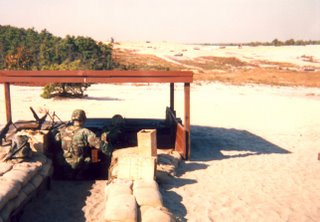
Noah Unsworth learning to shoot M60 Machine Gun
Whenever our platoon went anywhere that wasn't in marching distance, we were driven in what we called the Cattle Cars. It was a unique vehicle because the inside had two levels of wide benches, which allowed us to sit without taking off our large rucksacks, and only a few small windows up high that we couldn't see out of while sitting down. Personally, I loved the Cattle Cars because they gave me a chance to catch some sleep without fear of being caught by the Drill Sergeants who would sit in the front cab. The most comfortable position was to rest the front of my helmet against the flash suppressor on the point of my rifle which I would hold upright between my legs.

Front Leaning Rest Position - The official Army name for the push-up position which was normally proceeded by the command, "Half Left, FACE". Getting "Dropped" was the term we recruits used for when a Drill Sergeant would punish us with push-ups or worse, flutter kicks. I hated flutter kicks where we would have to lie on our backs with our feet raised off the ground, gently kicking our feet up and down. Wearing heavy boots and with my long legs, it was impossible to do it for any length of time which would quickly draw the ire of a Drill Sergeant.

Mail Call was one of the highlights of Basic Training. I was not much of a letter writer but getting mail was a fun break from the daily grind. Getting snacks in a care package would require push-ups as payment from the Drill Sergeant, but it was worth it.


With no books or magazines to read and television to watch, the only form of entertainment was practical jokes. The biggest, of course, was when one of the recruits would yell "At Ease" when we sitting in the classroom; cleaning our rifles, studying our manuals or trying to rest the eyelids. The first recruit to spot a Drill Sergeant entering the room is supposed to yell this so we can all jump up into the proper position, but jokers like to yell it whenever they saw someone with their eyes closed. I got pretty good at going from a sound sleep to my feet in a split second. The reason this joke is so effective is because the one time we ignored the call it turned out to be real and the Drill Sergeant got angry at our slow reaction.

We were always very tired in Basic Training. Any chance we could sneak a few moments of shut eye, we took it. This was always a bit dangerous if we were caught by a Drill Sergeant. One private had a Drill Sergeant throw a chair at him during class. The other danger was fellow recruits taking advantage of you. I mostly lucked out except for one day in the field when I was one of the guys who got sand poured into my mouth while asleep. The only real tool we had to fight this was popping No-Doze that we would buy at the PX (Post Exchange). It was effective, but I saved it for days I was really tired.


One of the things that surprised me at Basic Training was how much I enjoyed the food in the Mess Hall. I went in thinking I would be eating nothing but slop for several months, but it was delicious. The only problem is that I had to learn to eat fast. The Drill Sergeants made sure we finished our meals quickly without any talking. Each meal, our Drill Sergeant would alternate the order of each squad entering the Mess Hall. If we were at the end of the line, we would get less than five minutes to finish our meal after we got our food. I used to be a slow eater, not anymore. In Basic Training we had to pull KP (Kitchen Patrol) only three times. Each time I was assigned to removing the dishes, glasses and silverware out of the dishwasher.

View inside Company Formation from 3rd squad row.
Near the end of Basic Training we had a major barracks inspection by a Colonel. We had our area spotless and our lockers in perfect order so it went very well, but I had my most embarrassing moment of Basic Training. In the days before the inspection, the Drill Sergeants told us over and over to make sure we call the Officers who would be conducting the inspection, "Sir", and not "Drill Sergeant". The problem is that saying "Drill Sergeant" to address people in authority had become so ingrained that I accidentally called the Colonel, "Drill Sergeant". He laughed it off, but Drill Sergeant Santana gave me the evil eye.

We did a lot of running in Basic Training and a lot of that is running in formation. The pace is slower but it is tougher because we can't run at our own pace and we have to sing cadences at the top of our lungs instead of trying to breath. Beside the PT Tests, the most important run was the Battalion Run where all the companies in the battalion run together in one long formation. It was a six mile run which is much, much longer than I had ever run in the past. It was tough but I was happy that I finished without falling-out of formation like quite a few others.

When we were in the field we got to enjoy the food handed out in a MRE (Meal, Ready-To-Eat) for breakfast and lunch. It is a meal than comes sealed in a brown plastic sleeve that is supposed to last about three years in storage. They are more interesting to go through than to actually eat. They contained a vaccuum-sealed main course like spaghetti or beef stew which we could heat with a flameless heater or eat cold. Mostly I stuck to the packet of crackers with cheese spread and the dessert which was normally a bland tasting cookie. If I was lucky, I would get an MRE with a small bag of M&M's or Tootsie Rolls. The accessories packet had lots of cool little stuff like a tiny bottle of Tabasco, salt and pepper, a spoon, handy wipes, matches, and instant coffee and creamer. To complete the MRE, there would be a packet of cocoa powder or fruit drink mix. For dinner, we would get hot meals served from mermite cans which was much nicer.

In the field, one of the most important things is to never lose track of our rifle. The sergeants love to take it from us if we're not paying attention to it and make us pay to get it back. I freaked out when my rifle which had been leaning up against the tree next to me vanished. It was bad. I had to go and get it from the 1st Sergeant. The embarrassment was worse than the push-ups he made me do to get it back. I never took my hand off the rifle strap after that. We also had to sleep with our rifles in our sleeping bags. It is not the most comfortable thing to do and I found myself dreaming about it all night.

There are two types of crawling we learned to do in the Army, the Low Crawl and the High Crawl. They are both designed to be used if we have to move while under enemy fire. Which one we use depends on the amount of concealment available. In the High Crawl, we crawl on our elbows and knees holding our rifle across our arms. The Low Crawl is very slow with our whole body pressed flat on the ground, holding the rifle flat against the ground by the front sight. To put this all to the test, we had to use both types on a night course, crawling under barbed wire while M-60 machine guns were firing over our heads with flares going off. It wasn't too bad, but my uniform was filled with dirt at the end from the low crawl.

At the end of our field exercise, we had a 17 Mile March with a full pack from the field back to the barracks. We had a list of things we had to carry in our pack, but some guys cheated by not including everything. I carried everything I was supposed to which made the pack pretty heavy. We started in the evening and reached our barracks early in the morning. It was tough but not as bad as I had anticipated. The frequent rest breaks really helped. The nice part is that they let us sleep most of the day. It was very strange to be lying in our bunks in the daylight hours.


We chanted a lot of cadences while marching or running during Basic Training, but the best one is the special one we sing in the last week before graduation. I envied the platoons singing it while marching by when I was in Reception and couldn't wait until we could do the same thing. The "Goodbye Song" is not a regular Army cadence but it is sweet, "Na, Na, Na, Na... Na, Na, Na, Na... Hey, Hey, Hey... Goodbye."

Final formation before graduating Basic Training
I knew I had succeeded in Basic Training when on the last day, Drill Sergeant Santana had to look at my name tag to address me by name. My plan to keep a low profile with the Drill Sergeants had worked.

Link to my AIT post at Aberdeen Proving Ground, MD

Tuesday, October 09, 1990

Letter from Army Basic Training - 10/9/90

Hey Dad,

Here are the portrait pictures I was talking about. I've already sent about 7 off. There are also three pictures of my platoon in here. I am in the top row. I got Jordan and your letters. I also got a letter from Greg and sent Jake a birthday present, red U.S. Army sweat pants. I think he will like them.

Basic Training Army Portrait
I passed my PT Test. I am so Happy!!! I did 33 push-ups, 57 sit-ups and 14:30 on the 2 mile run. My platoon also won the PT Plaque because we had the most people to pass the first time.

Basic Training 3rd Platoon
Only a week left. You probably shouldn't send any more mail to this address because I will probably be gone before it gets here. I will send you my new address as soon as I get it.

There are four major tests or things you have to qualify with here at Basic Training. Only one more thing left, the (EOCT) or End-Of-Cycle-Test. We take it tomorrow. I think it will be easy.

Have I told you about Bubba yet? He is a guy in my platoon who comes from Encinitas too. He lived on North Vulcan. It's pretty weird that all the way across the continent there is a guy who lived like almost across the street. He is a pretty nice guy. His real name is Arthur Gomez.

Oh well, the next time I'll write you will be from Aberdeen.

PVT. UNSWORTH, NOAH
A Co. 3rd BN 26th Inf
Fort Dix, NJ 08640-7031

Sunday, September 30, 1990

Letter from Army Basic Training - 9/30/90

Hey, Dad.

I got your letter. Thanks for the money. I'm doing fine. This past week has been sort of a slow week. We had KP, Monday and Thursday. I hate KP, all we do all day is clean. Because my platoon had KP, we missed the obstacle course and night fire. That's where you get to shoot in automatic with tracer rounds.

We got our uniforms Tuesday. They're pretty fancy. I can't wait till I get to wear it. Friday was not a very good day. We had Drill Competition that morning and we came in second. We got a streamer for our flag but we didn't win like we were expecting to. Our Drill Sergeant said that our grader was the hardest of the two. We also lost the Barracks Maintenance streamer for this week for the first time. We lost by two points, just like in the Drill Competition. It we had won it this week, we would have been able to keep the streamer permanently. We think that the First Sergeant let one of the other platoons win because they were complaining that we were always winning.

We also went to Evening Colors that day. That's were we have to stand perfectly still in the positions of Attention and Parade Rest for about a hour. We have to compete against other companies for the Evening Colors streamer. One guy in 2nd Platoon fainted during the ceremony. In one of the female companies, five girls passed out. Our company didn't win, but again we think there is foul play involved. One of the reviewers who graded our company was a Drill Sergeant for our company and was kicked out. Our Company Commander said that we had deserved to win. He said that several officers had come up to him and congratulated him for winning who were at the ceremony. He said that they were surprised when they found out we didn't win because they thought we looked the best.

Saturday, we had phase testing and we phased into the Blue Phase. We also took a PT test in the morning. I did 34 push-ups, 46 sit-ups and ran the 2-mile in 14:39. I qualified in everything. That means in 2 weeks when we take the APRT Test, I will pass. The requirements are only 32 push-ups, 42 sit-ups and 15:54 on the run. I'm pretty happy about that. In the beginning of Basic Training, I was pretty worried.

I put two pictures that I had taken in a photo booth last week during pass in the envelope for you to look at. They have paper stuck to them because I stuck them in my pocket when they were still wet. I got one of those disposable cameras. I have taken a few pictures already. I'll send it home when all 24 pictures are taken. I'm waiting for next week when we go on Tactical Bivouac before I take the rest of the pictures. I hope they all come out good.

We get paid Monday and we also get our portraits next week. I'll send those when I get them. Well, I've been sitting around too long. I got to clean this room. I'll call soon as I get a chance.

Love, Noah

PVT. UNSWORTH, NOAH
A Co. 3rd BN 26th Inf
Fort Dix, NJ 08640-7031

Saturday, September 22, 1990

Letter from Army Basic Training - 9/22/90

Uncle Dan,

Thanks for your letter. I'm glad you were able to go to my going-away party. Too bad you didn't jet-ski, it was fun. The weather is starting to get cool here. It has been raining all day today.

Yesterday, we finished BRM (Basic Rifle Marksmanship). We had to qualify on the M-16 rifle by shooting a certain number of pop-up targets. I got the Marksman Medal. I'm looking forward to pinning it on my Dress Greens we get Tuesday. Tonight we get to go to a concert and tomorrow we get to go on Pass. We'll be able to eat anything we want.

We're going to learn how to shoot the M-60 machine gun too. We just don't have to qualify with it. We pull guard duty next week. We go out in the middle of nowhere and guard an ammunition dump full of live ammo. It should be pretty interesting.

Well, I got to stop writing now, out of time.

PVT. UNSWORTH, NOAH
A Co. 3rd BN 26th Inf
Fort Dix, NJ 08640-7031

Letter from Army Basic Training - 9/22/90

Hello Dad,

I got your letter. Thanks for Scott's address.

Today we finished BRM (Basic Rifle Marksmanship). We had to qualify with our M-16s. We had to get 23 out of 40 pop-up targets. I got my first badge today, a Marksman medal. I hit 26 targets. I didn't do as well as yesterday. I hit 30 then. If I had hit that today I would have gotten the Sharpshooter medal. I think that I was too nervous, so I screwed up my shots.

My platoon won the BRM Streamer because we got the best percentage of qualifiers. We now have two streamers on our flag. The Barracks Maintenance and BRM.

We get to go on pass Sunday. We also have a concert Saturday night. We did a lot of marching this week. We marched about 16 miles with full pack, all together. I'm lucky, I only got a couple of blisters compared to other people.

We got another haircut today. This time they only cut around the hair on the sides leaving the top to keep growing. I like it. We also get our Class A Uniforms next week. They look like the ones the recruiter wore. We get a dress green jacket and patent leather shoes.

Only two more weeks until the PT Test. To pass, you have to do 32 push-ups, 42 sit-ups and 15:54 on the 2 mile run. I should be able to pass if I continue to work hard. I can already do the run on time.

We also pull a 24 hour guard duty next week. They take a group of us out into the middle of nowhere with our rifles and live ammunition and we have to guard an ammunition dump.

Tomorrow, we have the IET Challenge. That's where our company, Alpha Company, competes against other companies within our battalion. It's kind of like a field day at school.

This coming week is our last week in White Phase, next week we move into our last phase, Blue. In that phase is where we have the tactical bivouac with the 15 mile night hike.

It's starting to get chilly here in the mornings. I hope it warms up a bit.

I'm glad to hear some people are interested in my car. I've written Jake already, hopefully he'll write back. Grandma and Grandpa DeVol have been on a trip to Alaska and have been sending me postcards. Could you send some pictures? Some from the Going-Away party. At least one with a picture of Scott and Greg in it, please.

Well, I have to go. I've been writing this after lights-out with a flashlight and I'm getting tired.

Love, Noah

PVT. UNSWORTH, NOAH
A Co. 3rd BN 26th Inf
Fort Dix, NJ 08640-7031

Sunday, September 16, 1990

Letter from Army Basic Training - 9/16/90

 Dear Aunt Melody,

Thanks for your letter, it really improves my day when I get letters. I just got back from a 4-day bivouac out in the woods. There is so much sand out there, it gets everywhere, my clothes, sleeping bag, boots, and in my rifle. The worst part was no showers. We spent each day on the range, firing our weapons and we had to clean our weapon every night.

There's a lot of guys here my age, some of the guys are still 17 years old. My Ranger Buddy is 23. His name is Roger. He's a nice guy.

What worries me here, is that if war breaks out in Saudi Arabia and they need more men I might have to go. I doubt it but there is still a chance. My MOS is 44B, which is welding, and they don't have a big need for that over there. Roger's MOS is one of the critically need ones so he probably be going. Enough of worrying, how are you doing? I am buying pictures, I'll make sure to send you one.

About the goodies, you can send some just not too much or too often. We are allowed only ten minutes to eat what we get.

Well, I have to go now. Please write again.

Love,
Noah

PVT. UNSWORTH, NOAH
A Co. 3rd BN 26th Inf
Fort Dix, NJ 08640-7031

Tuesday, September 11, 1990

Letter from Army Basic Training - 9/11/90

Hey Jake,

How is Boston? I've been doing pretty good here. We wake up around 4:00 in the morning and go out and exercise. Once a week we have a 4 mile run.

Today we had to go into a gas chamber filled with tear gas. We had to take off our gas masks and stay in there for one minute. The gas totally burns your eyes, nose and throat. I felt like I was going to die.

Starting tomorrow we're going out to the firing range to learn how to shoot our M-16's.

I don't don't get to read any books here. I have allot of new friends. The name of my platoon is the "Rangers".

I am buying a jacket that has a skull with blood dripping out of it's mouth with two crossed M-16s behind it, on the back. The front has my name and patches saying "Rangers", "U.S. Army" and an American Flag on it. It's a flight jacket.

I'll probably see you at Christmas. I'll try to call you.

PVT. UNSWORTH, NOAH
A Co. 3rd BN 26th Inf
Fort Dix, NJ 08640-7031

Wednesday, September 05, 1990

Letter from Army Basic Training - 9/5/90

Dad,

Today we practiced throwing hand grenades, yesterday we had hand-to-hand combat training. I learned a lot of throwing moves and how to land correctly. Did you get the travelers checks I sent you? Make sure you take all my maps and Automobile Club stuff out of the glove compartment of my car before you sell it, please.

I had Fireguard last night from 1 to 2 in the morning. We had gotten back to the barracks late from a religious retreat so I didn't have time to shine my boots so I did it during fireguard.

It is starting to get chilly here in the morning. Standing outside at 4:30 in the morning in a T-shit and shorts is not fun. They warm you up though with the 2 mile run and exercises.

The reason I keep writing you with this small notepad paper is because this is the only paper I carry around with me all day, so when we have a break I can write.

9/6/90

This morning we learned how to use a field phone, use the right radio lingo, and we also learned how to use the field radio, too. Lunch was good. I had two roast turkey sandwiches. We burn it all off though and I'm already hungry before dinner.

We did Pugil Stick training today. That's where you wear a football helmet, gloves, pads and try to beat each other with padded sticks. You try to score points against your opponent by getting a good hit on them. It was for two out of three points. I won my match, 2 to 0.

On the way back, when we were singing cadence, we screwed up and made a turn before the Drill Sergeant gave the command. He got mad and when we got back to the barracks, he made us do so many exercises that the floor was slippery with sweat.

After dinner, we used the Weaponeer, it is a piece of equipment that tells you how good a shot you are.

9/7/90

This morning we had another company run, 4 miles, at even a faster pace. I made the whole run without stopping or falling out of formation. We learned how to set up a claymore mine. We got another haircut today, just when it was starting to grow again. After lunch, we went to a firepower demonstration. It was so loud that we had to wear earplugs.

My platoon won the barracks award for the second time in a row. Tomorrow our company goes into the "White" phase of basic training. There are three phases, Red, White & Blue. We'll get more freedom and privileges in the white phase. I finally got my glasses.

We're going to bivouac, or camping in civilian terms, for five days and four nights. We'll concentrate on firing our M-16's at the range. We go into the gas chamber on Monday. They say don't eat very much before or you will probably throw it up.

I got your letter today. Thanks for the money. About the stolen money, they didn't take the wallet luckily. Don't send the Sports Illustrated magazines because we are not allowed to have books or magazines. How did the family portrait come out? Is Jordan and Joel having Home School again this year or are they going to Encinitas Christian school again? Could you look in the phone book under Scott Dale and send me the address and phone number, please. Thanks. I sent letters to all the relatives who asked me to write them. Well, I've written enough. Keep in contact.

I love you, Noah!

PVT. UNSWORTH, NOAH
A Co. 3rd BN 26th Inf
Fort Dix, NJ 08640-7031

Sunday, September 02, 1990

Letter from Army Basic Training - 9/2/90

Dear Aunt Melody,

I’m sorry you couldn’t make it to my Going Away Party. It was fun. I am at Fort Dix right now. The plane trip here was pretty exciting, I saw the Grand Canyon and the Great Lakes. It is pretty tough here, but I’m told it gets easier. We have already got our M-16 rifles. We do alot of PT, physical training, yesterday morning we ran 4 miles at 4:30 in the morning. The food is quite good surprisingly. My address here is,

PVT. Noah Unsworth
A Co. 3rd BN 26th INF
Ft. Dix, N.J. 08640-7031

untill Oct. 19 when I leave for Aberdeen Proving Grounds. Make sure you write (3rd plt) in the lower left hand corner of the envelope. Say “Hi” to the rest of family. I have many new friends here. The only thing that bothers me is that if we go to war with Iraq I might have to go to Saudi Arabia. Oh well? I hope you are doing good. I should be home by the middle of March. I will also be home for two weeks during Christmas time.

Love,
NOAH

Saturday, September 01, 1990

Letter from Army Basic Training - 9/1/90

Hello Dad,

This morning we got up at 3:30 in the morning and had a four mile run. We had to run in formation and couldn't stop the whole time.

Right now I am on a break from our First Aid class. We got portraits done with us in our uniforms. I will send them home when I get them.

My platoon got first place in barracks clean-up competition between the company's platoons. We got a streamer for our flag, a plaque and our platoon gets to carry the company flag.

PVT. UNSWORTH, NOAH
A Co. 3rd BN 26th Inf
Fort Dix, NJ 08640-7031

Friday, August 31, 1990

Letter from Army Basic Training - 8/31/90

Hello Dad,

We got our M-16's yesterday and we practised with bayonets. The "Butt Stroke" and the "Slash and Thrust" were some of the moves we learned.

I also got another painful shot yesterday for the American Measles. They use one of those pressurized shotguns.

I am getting good at marching in formation, shining my boots, and cleaning the barracks. I've had KP twice, Tuesday and today. My job is to pull dishes out of the dishwasher and stack them.

Two other guys and I got dropped, had to do push-ups and flutter-kicks, for about 15 minutes because we didn't tell the guy next to us his hat was crooked.

Today was pay day. We cashed our checks and got Traveler Checks. I'm sending home $200 worth in this envelope. Could you keep them in a safe place until I get home?

PVT. UNSWORTH, NOAH
A Co. 3rd BN 26th Inf
Fort Dix, NJ 08640-7031

Saturday, June 16, 1990

San Dieguito High School Graduation

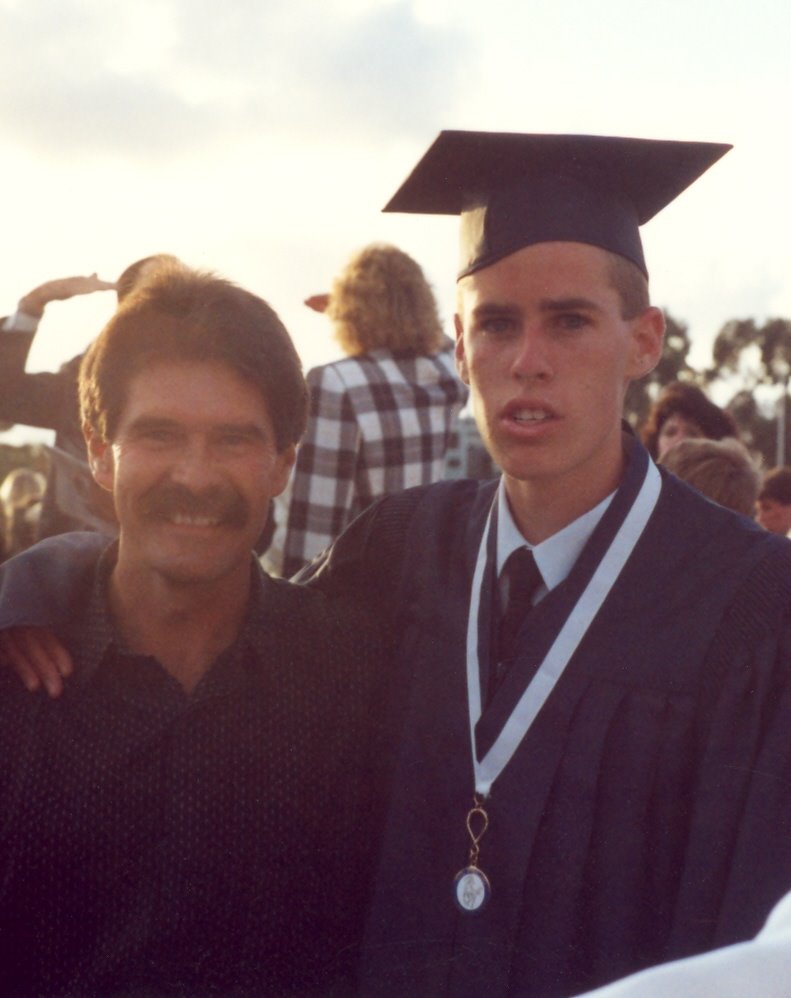
Noah and his father after High School Graduation
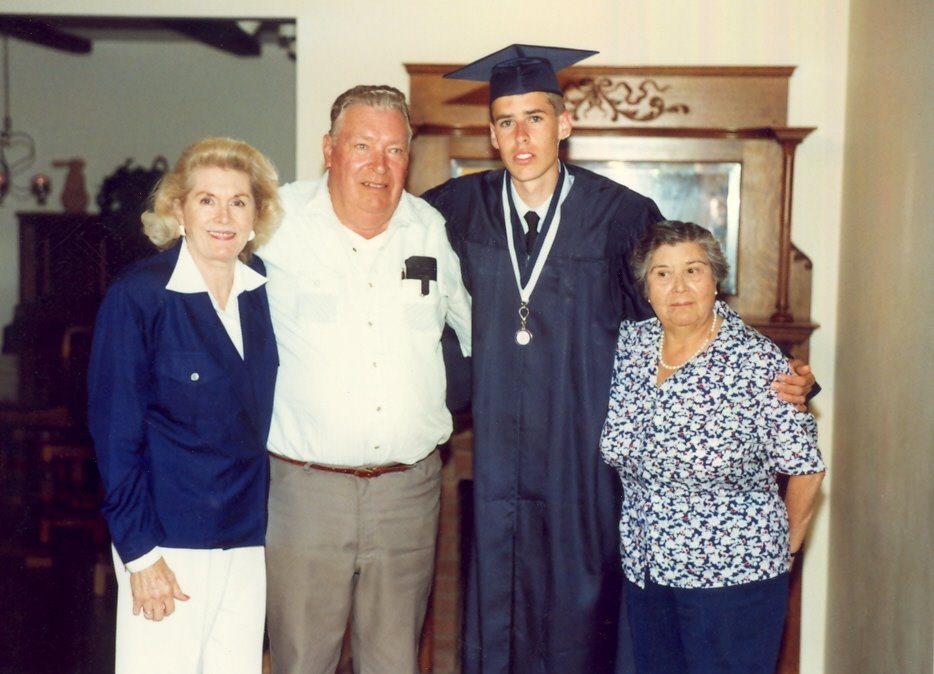
I graduated from San Dieguito High School this week, Class of 1990. It was a bigger moment in my life than when I turned 18, six months ago. It is hard to feel like a true adult when you are still going to classes in High School. A bunch of my relatives came to watch the Graduation Ceremony when I walked across the stage to receive my diploma. We all went out to dinner afterwards to celebrate at Neimans in Carlsbad. After dinner, I went to the Grad Night Party to celebrate with the rest of my class.

Noah and his Grandparents after High School Graduation
Grad Night was an all-night party in the school gym that lasted until the morning. It was real fun. We ended up popping the inflatable bouncer by having too many people jumping around inside at once. At one point I was buried under a dogpile, slowly being pressed down against the concrete as it deflated. We also had a casino area where I won a lot of fake money at the craps table. I turned it in for a bunch of raffle tickets at the end of the night but still didn't win anything. The best part of the night was the hypnotist show. It was very hilarious but it is hard to believe that it is not fake somehow. After the party ended, I took a little walk through the empty school for the last time, reflecting a little bit on my time there.

Tuesday, April 09, 1974

My Father's Time in the Alaska Oil Fields (1973-74 in Prudhoe Bay)

Here is the story, as told to me by my father, Robert Unsworth, of his time in Alaska in the winter of 1973-1974, working the oil fields. After the story, is a brief historical overview of that time period in Prudhoe Bay and the seismic surveys he participated in.

Heading to Alaska

In the late months of 1973, the coastal economy of Southern California began to stall. For Robert Unsworth, a 22-year-old journeyman carpenter with a newborn son, Jake, and a toddler, Noah, the lack of work was more than a professional frustration—it was a threat to the future he was building on a third-acre lot in Leucadia.

His mother-in-law, Marion DeVol, stepped in to bridge the gap. She hired Robert at her business, the DeVol Pet Center in Santa Ana, paying him his full journeyman’s wages to handle odd jobs. It was there, two weeks into the work, that a friend walked through the doors with a wild proposition: there was work to be had in Alaska.

Just before Christmas, Robert and his friend, Johno, left the warmth of California for the frozen reality of Fairbanks. They arrived as a team—Robert, the experienced Journeyman, and Johno, the Apprentice. When they reached the local union hall, the dynamics of the era became clear. Because Robert was Native American, the union offered him a position immediately. However, they refused Johno because of his apprentice status. Robert didn’t hesitate; he refused the job, telling the union he wouldn't work without his partner.

While Johno’s family back in California scrambled to pull strings and send up the Journeyman paperwork for him, the delay cost them. By the time Johno was "official," the specific carpentry jobs—building the massive wooden forms for the pipeline’s concrete supports—had been filled.

The two men found themselves in a Fairbanks basement, renting cots alongside a dozen other workers. Seeking a new path, they applied for positions with Geophysical Service Inc. (GSI), which was conducting seismic surveys across the Prudhoe Bay. On the way to their interview, they caught a ride with a local man named Bud. When Bud realized he had two skilled carpenters in his car, he made a trade: if they would insulate and drywall two small houses he owned, he would provide them with room and board at his home while they waited for the GSI call.

Robert and Johno moved out of the basement that same day. They attacked the first house with such speed that they finished it in twenty-four hours. Bud, stunned by the quality and pace, laughed and asked, "What am I going to do with you guys?" When winter frost made digging foundations for a local bank impossible, Robert had an idea. He had Bud set up canvas tents over the frozen earth and blasted the ground with diesel space heaters until the soil softened. Bud was so impressed he began paying them money on top of their room and board. They stayed with him for a month, though GSI called within two weeks to offer them the job. The company was so eager to get them to the North Slope that they put both men on the payroll immediately, two weeks before they even stepped foot in Prudhoe Bay.

A North Slope Education

Before flying north to Deadhorse, Bud took Robert to a local supply store to buy the heavy-duty overalls required for survival in Prudhoe Bay. They were the uniform of a new world, one where the first day on the job involved a "Prudhoe initiation." Robert and Johno were sent out to the airfield to light smudge pots with matches to guide in a cargo plane. After several minutes of struggling with freezing fingers and failing matches, the veteran crew finally revealed the propane torches actually used for the task.

The true baptism, however, came when the cargo plane landed. As the crew began offloading diesel fuel, a transfer hose was handed to Robert; it leaked, drenching the chest and legs of his overalls in a gallon of fuel. For the next four months, the scent of diesel became his second skin.

Robert began his time with Geophysical Service Inc. (GSI) as a "Juggie," placing geophones into auger holes along survey lines—marked with red flags for inland and blue for the shore. When a driller’s helper departed for Canada, Robert seized the opportunity. He moved from geophones to the rig, eventually becoming a driller himself, responsible for boring the holes and setting dynamite along the blue-flagged shoreline.

The work was dangerous and precise, but human error was always a factor. One day, a surveyor mislaid the blue flags inland. Because the technique for shoreline drilling differed from the tundra, the auger repeatedly seized in the frozen earth. As the crew used a torch to thaw the equipment, they struck a gas pocket. The back of the rig ignited instantly. Knowing the truck was loaded with dynamite, Robert and the crew fled into the deep snow, fearing an imminent explosion. They had not run far when a sudden, powerful arctic wind swept across the plains, miraculously blowing out the flames before the fire could reach the blasting caps.

Though a "Shooter" offered to train him inside the warm, computer-filled "Doghouse" van to record seismic readings, Robert declined. He was a man of the outdoors and preferred the physical rhythm of the rig to the confusion of the special instruments.

His favorite memory of the north, however, was one of profound silence. While driving a rig to a civilian weather station to fill up the water tank, the Northern Lights erupted with such intensity that he turned off the engine and stood in the vast, dark quiet for thirty minutes, watching the sky. When he finally arrived, the station operator greeted him with a knowing smile. "What took you so long?" the man asked, but he guessed before Robert could answer, “Watching the lights?". He told Robert to tell his supervisor the pump had malfunctioned—a small gift of time between men working at the edge of the world. 

The Return to California

In early 1974, as the ice began to melt and the drilling rigs were pulled off the softening tundra, a call came from a family friend. Robert was told he needed to come home. He and his wife separated shortly after his return; at 22, the pressures of the era had taken their toll.

Robert took his two young sons, Noah and Jake, and moved south to the 1/3 acre lot on Jasper Street in Leucadia he had purchased two years earlier with his one-time payment from the 1972 Judgment Fund Roll of California Indians. For years, the three of them lived in a fifth-wheel trailer parked in the driveway, beside a freestanding garage Robert had built himself.

Between carpentry jobs and raising his boys as a single father, Robert chipped away at the Tudor-style house he was building on the property. The stucco, the dark beams, and the leaded glass windows were installed piece by piece over the following years. Finally, in 1980, when Noah was ten years old, the trailer was traded for the house.


The winter of 1973–1974 was arguably the most pivotal moment in the history of the North Slope. Robert arrived at Prudhoe Bay just as the "Oil Rush" shifted from a crawl to a frantic sprint.

Here is the historical context of what he experienced during those four months and how his work for GSI (Geophysical Service Inc.) fit into the birth of the Trans-Alaska Pipeline.

1. The Global Catalyst: The 1973 Energy Crisis

When Robert left for Alaska in December 1973, the world was in the grip of the Arab Oil Embargo. Gasoline prices in the Lower 48 had quadrupled, and there were massive shortages.

  • The Pipeline Act: Just weeks before Robert flew to Fairbanks, President Nixon signed the Trans-Alaska Pipeline Authorization Act (November 16, 1973). This law bypassed all environmental lawsuits that had stalled the project since 1968.
  • The Rush: Because the government had finally given the "green light," every oil company (BP, ARCO, Exxon) was desperate for seismic data to finalize exactly where to drill their production wells before the massive construction of the pipeline began in April 1974.

2. GSI: The "High-Tech" Pioneers of the Tundra

Geophysical Service Inc. (GSI) was not just any contractor; they were the world leader in seismic technology (founded by the same men who started Texas Instruments). Their job was to "see" into the earth to find the edges of the oil reservoir.

  • Seismic Surveys: Robert's crew was performing Reflection Seismology. They were essentially taking an "X-ray" of the earth's crust by sending shockwaves (dynamite) down and measuring how they bounced back.
  • The "Flag" System: The red and blue flags he remembered were Survey Stations.
    • Red Flags (Inland): These marked lines over the permafrost (tundra). Drilling here was tricky because if the auger generated too much heat, it would melt the permafrost and get stuck—exactly what happened when he was accidentally drilling inland instead of on the shore.
    • Blue Flags (Shoreline/Offshore): These marked the "transition zone." Drilling on the frozen sea ice or the shoreline required different pressures because you were dealing with salt-ice and shallow water rather than frozen soil.

3. The Drilling Job: Danger and Hierarchy

Robert's progression from "Juggie" (placing geophones) to Driller was a significant step up in responsibility.

  • The Hazards: The gas pocket fire he experienced was a known and feared danger. USGS records from that era specifically warn about "shallow gas pockets" trapped under the permafrost. When a drill bit hits one of these pockets at high speed, the friction can ignite the gas instantly.
  • The "Shooter" and the "Doghouse": The man who offered to train him was the Shooter (or Observer). They worked inside a "special van" called the Doghouse. It was filled with cutting-edge (for 1974) magnetic tape recorders and computers. While it was warmer, it was also tedious, high-pressure work—validating why a man of Robert's "outdoor" temperament preferred the rig.
  • The Auger Rigs: In 1974, these were often mounted on Rolligons (massive, low-pressure tires) or sleds to avoid damaging the fragile tundra, which was a major legal requirement of the new Pipeline Act.

4. Life at Deadhorse and the Weather Station

In 1973, Deadhorse wasn't a town; it was a collection of modular "camps" made of shipping containers and trailers.

  • The Civilian Weather Station: The "man" your father met was likely an observer for the National Weather Service (NWS) or the FAA, which operated a station at the Deadhorse Airport (established in the late 60s). Because there were no satellites or cell phones, these weather observers were the only lifeline for pilots flying the "Hercs" (Hercules cargo planes) your father saw.
  • The Northern Lights: The winter of 1974 was during a period of high solar activity. For a man who had just come from the orange groves and suburbs of Santa Ana, seeing the Aurora over the North Slope—undisturbed by any city lights for hundreds of miles—would have been a life-altering sight.

5. The Surrounding Years: Before and After

  • Before (1969–1972): This was the "Great Freeze." Oil had been discovered in 1968, but the project was tied up in courts. Alaska was in a recession. People were leaving. Robert arrived just as the "boom" finally broke the ice.
  • After (April 1974–1977): Just months after he left (early 1974), the Dalton Highway (Haul Road) was built in just 154 days. Tens of thousands of workers flooded the North Slope. If he had stayed even six months longer, he would have seen the transformation of Prudhoe Bay from a quiet scientific survey site into the largest construction project in American history.


During the 1973–1974 seismic surveys in Prudhoe Bay, the Auger Rig was the workhorse of the North Slope. Because the goal of Geophysical Service Inc. (GSI) was to map the subsurface using shockwaves, these rigs had to be fast, mobile, and capable of drilling through some of the hardest frozen material on Earth.

Here is the technical breakdown of how Robert’s rig operated and how the "shot holes" were prepared.

1. The Rig: A Mobile Drill Platform

On the North Slope, the rigs were typically mounted on Rolligons (trucks with massive, ultra-low-pressure tires) or tracked vehicles to prevent the heavy equipment from breaking through the delicate tundra.

  • The Kelly Bar & Auger: The "drill bit" was a continuous flight auger—essentially a giant screw. This was attached to a Kelly Bar, a long square or hexagonal steel rod that the rig’s motor would rotate.
  • The Power: These were high-torque hydraulic systems. Unlike a water well drill that uses fluid to flush out dirt, an auger works like a corkscrew, physically lifting the "cuttings" (frozen dirt or ice) up the spirals of the screw to the surface.

2. The Drilling Process: Inland vs. Shoreline

Robert’s story about the wrong flags highlights the two very different environments they worked in:

  • Inland (Red Flags): You were drilling into Permafrost. This is soil and gravel frozen harder than concrete. If the driller ran the auger too fast, the friction would create heat. This heat would melt the permafrost, turning it into a "slurry" or "gumbo" that would instantly refreeze the moment the drill stopped, "pinning" the auger in the hole.
  • Shoreline (Blue Flags): Here, you were often drilling through sea ice or "bottom-fast ice" (ice frozen all the way to the sea floor). This required different rotational speeds and downward pressure because ice behaves differently under a drill bit than frozen gravel does.

3. Placing the Charge (The "Load")

Once Robert reached the target depth (usually 50 to 100 feet), the auger was pulled out, leaving a clean "shot hole."

  • The "Sausage" Charges: The dynamite used was not the sticks you see in movies. It was often specialized seismic explosives, like Nitramon, which came in threaded metal or plastic canisters that could be screwed together into long "sausages."
  • The Cap & Lead: A Blasting Cap was attached to the top charge. From this cap, two insulated wires (the "leads") ran all the way up the hole to the surface.
  • The "Juggie" Connection: While Robert drilled and loaded, the "Juggies" (his previous job) were laying out miles of Geophones—sensitive microphones spiked into the ground—connected by cables to the "Doghouse" van.

4. The "Blow" and the Reading

Once the hole was loaded and the rig moved a safe distance away, the Shooter in the van took over.

  1. They would send an electrical pulse down the wires to the blasting cap.
  2. The dynamite would detonate, sending a massive "thump" of energy into the ground.
  3. That energy would travel down, hit different rock layers, and bounce back up.
  4. The geophones would "hear" the bounce-back, and the computers in the van would record it.

The Gas Pocket Risk

The "gas pocket" Robert hit occurs because as the auger grinds through the permafrost, it can pierce a small, pressurized pocket of biogenic methane (gas formed by ancient decaying plants trapped in the ice).